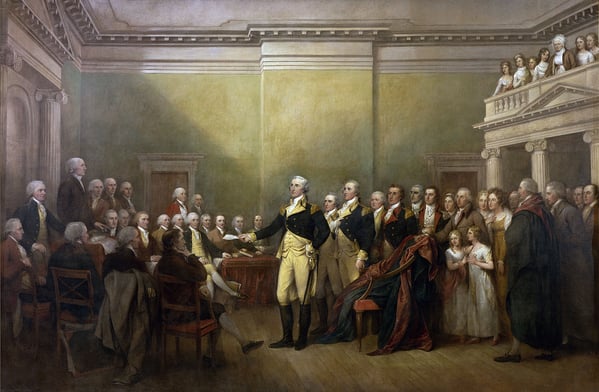
General George Washington Resigning his Commission
Details
Expertenanalyse zu John Trumbulls General George Washington Resigning his Commission
Stil: Neoclassicism · Genre: history painting
This painting, General George Washington Resigning his Commission (1824), is a defining work of American Neoclassicism and a masterful example of history painting as moral instruction. Hanging in the U.S. Capitol Rotunda, it captures one of the most consequential moments in the founding of the republic—a voluntary transfer of power that distinguished the new nation from the monarchies of Europe.
Significance within Neoclassicism and History Painting
Trumbull employs the fundamental Neoclassical vocabulary: balanced composition, clear spatial recession, and idealized, statuesque figures dressed in contemporary but dignified clothing. The scene is not a chaotic battle but a calm, ceremonial tableau, emphasizing reason and civic virtue over dramatic action. The architecture of the Maryland State House frames the event with classical columns and a coffered ceiling, lending timeless gravity to the proceedings.
What makes the work historically profound
The painting's true significance lies in its subject: Washington surrendering his military authority to the Continental Congress. This act, performed in 1783, was considered shocking in an age of ambitious generals. Trumbull captures the moment just after Washington bows, pointing to the document on the table—his commission—while Congress President Thomas Mifflin gestures in acknowledgment. The deliberate absence of martial pomp foregrounds the principle of civilian control of the military.
Composition and symbolic details
Trumbull places Washington slightly off-center, stepping upward as if leaving the stage, while the seated Congress remains static—the enduring institution outlasts the individual leader. The dark, sober clothing of the delegates contrasts with Washington's blue-and-buff uniform, understated yet heroic. The chair (with its carved sunburst) and the empty chair next to Washington (meant for Martha) reinforce the domestic and republican virtues at stake. Light falls on Washington's face and the document, drawing the eye to the crux of the narrative.
Artistic and patriotic legacy
As one of four large history paintings Trumbull executed for the Capitol, this work helped codify the iconography of American democracy. It transforms a specific historical event into a universal lesson: that power relinquished is as noble as power attained. The painting's Neoclassical clarity—its balanced masses, restrained emotion, and legible story—makes it a lasting textbook of republican ideals, ensuring that Washington's act of self-denial remains a foundational myth of the United States.
Museum / Gallery
Genre
Stil
Visuell ähnlich
20 Werke mit ähnlicher Komposition und Farbpalette
Declaration of Independence
Asher Brown Durand
The Declaration of Independence, July 4, 1776
Edward Hicks
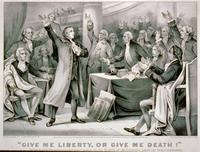
Patrick Henry speaking before the Virginia Assembly
Currier and Ives
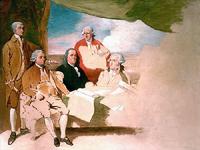
American Commissioners of the Preliminary Peace Negotiations with Great Britain
Benjamin West
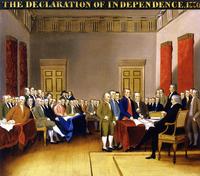
The Declaration of Indepenence
Edward Hicks
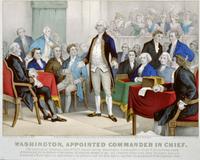
George Washington after his appointment as commander in chief of the Continental Army
Currier and Ives
Scene
Walter Sadler
Draft for the Signing of the Declaration of Independence
Martín Tovar y Tovar
The Connoisseurs. John Caw, John Bonar and James Bruce
David Allan
Writing the Declaration of Independence, 1776
Jean Leon Gerome Ferris
Lomonosov in Germany. The scientific Debate.
Eugene Lanceray
Celebrating childbirth, from act IV of Ludvig Holberg's play Barselstuen
Wilhelm Marstrand
The Gaols Committee of the House of Commons
William Hogarth
The First Council of Queen Victoria
David Wilkie
Distribution of Awards to Artists at the End of the 1824 Salon, January 15, 1825
Charles de Steuben
Red Coat Soldiers Toasting the Ladies of the House
Howard Pyle
Riksforsamlingen at Eidsvoll
Oscar Wergeland
First meeting of Washington and Lafayette
Currier and Ives
The Reception of Cornelis Hop (1685-1762) as Legate of the States-General at the Court of Louis XV, 24 July 1719
Louis-Michel Dumesnil
Atelier of Madame Vincent
Marie-Gabrielle Capet