Analisi esperta di Adam and Eve Expelled from Paradise di James Ensor
Stile: Symbolism · Genere: religious painting
Expert Analysis: "Adam and Eve Expelled from Paradise" by James Ensor
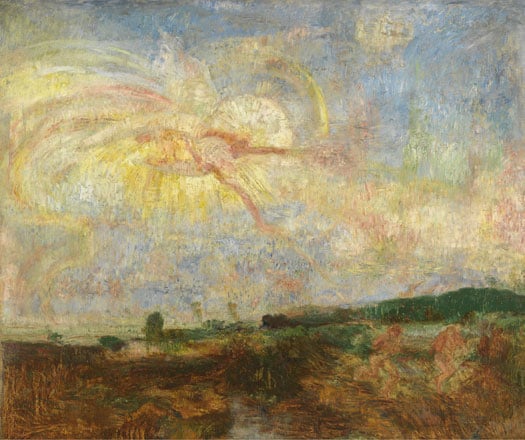
James Ensor’s "Adam and Eve Expelled from Paradise" is a striking example of Symbolist religious painting that subverts traditional Biblical narrative through a deeply personal, psychologically charged lens. Created at the height of Ensor’s engagement with Symbolism (circa 1887), the work transforms a familiar scene of divine judgment into a claustrophobic, grotesque spectacle that reflects the artist’s own disillusionment with institutional religion and societal hypocrisy.
Significance within Symbolism
As a Symbolist work, the painting rejects literal representation in favor of emotional and metaphysical resonance. Ensor displaces the Edenic garden and its clear moral hierarchy with a compressed, almost suffocating space. The figures of Adam and Eve are not idealized archetypes but distorted, mask-like presences—a hallmark of Ensor’s style. Their expulsion becomes less a theological lesson than a haunting allegory of human alienation, guilt, and the absurdity of existence. The angel driving them out is less a celestial messenger than a menacing, carnivalesque figure, echoing Ensor’s fascination with masks and the grotesque as tools to expose hidden truths.
Religious Painting Reimagined
Traditionally, religious paintings of this subject emphasize sin, punishment, and the hope of redemption. Ensor instead focuses on the psychological trauma of exile. The lush, symbolic details typical of earlier depictions give way to an angular, almost nightmarish landscape. The color palette—muted earth tones punctuated by stark whites and sour yellows—intensifies the sense of dread. This work stands out for its refusal to offer comfort or moral clarity; instead, it forces viewers to confront the raw, unsettling emotions of shame, fear, and displacement.
Cultural and Artistic Context
Ensor’s radical reinterpretation aligns with Symbolism’s broader rejection of naturalism and its embrace of subjective, often dark inner vision. At the time of its creation, Belgium was undergoing rapid industrialization and social change, and Ensor’s art increasingly critiqued bourgeois piety and institutional power. "Adam and Eve Expelled from Paradise" can be read as a critique of the Church’s control over human guilt—a theme that would reach its fever pitch in Ensor’s Christ’s Entry into Brussels in 1889.
Legacy
This painting is significant because it demonstrates how Symbolist artists could take a canonical religious subject and inject it with modern anxiety, psychological depth, and biting satire. Ensor’s fusion of the sacred and the profane, the biblical and the grotesque, paved the way for Expressionism and Surrealism. It remains a potent reminder that Symbolist religious painting is never about dogmatic faith, but about the terrifying, beautiful, and often absurd struggle of the human condition.
Genere
Stile
Visivamente simili
20 opere con composizione e palette affini
Plain when it gets dark
Giovanni Segantini
Sunset
Mykhailo Vainshtein
Summer Landscape
John Henry Twachtman
Sunlit Hillside
Robert Julian Onderdonk
Réve Bleu
Theo Gerber
Two Bathers in a Landscape
Pierre-Auguste Renoir
Landscape
James Ensor
On the Lakeshore
Kimon Loghi
Misty May Morn
John Henry Twachtman
The autumn sun
Ivan Grohar
Gathering Clouds
Benjamin Brown
Two Figures by the Water
Pierre-Auguste Renoir
Bathers
Odilon Redon
Landscape
Pierre-Auguste Renoir
The Brook, Greenwich, Connecticut
John Henry Twachtman
Sunrise at Ramiro Spring
Armando Reveron
Landscape
Armando Montaner Valdueza
I Will Remember Nothing Escapes Me
Paul F. Yount
Landscape
Paul Gauguin
June
Thomas Dewing