Expertenanalyse zu James Ensors Ensor at the Harmonium
Stil: Expressionism · Genre: self-portrait
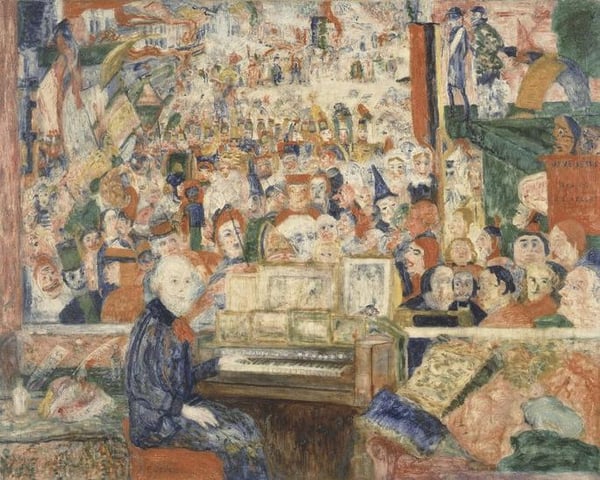
Expert Analysis: "Ensor at the Harmonium" by James Ensor
As an expressionist self-portrait, James Ensor’s “Ensor at the Harmonium” stands as a pivotal work that encapsulates the artist’s fierce individuality and his critical role in the evolution of modern art. The painting belongs to the broader Expressionist movement, which prioritized subjective emotion and psychological depth over naturalistic representation. Here, Ensor uses the genre of the self-portrait not merely as a record of his likeness, but as a stage for self-dramatization and introspection.
The inclusion of the harmonium—a reed organ often associated with domestic music making—is significant. In Ensor’s hands, this humble instrument becomes a symbol of both creative isolation and the artist’s role as a dissonant voice. The self-portrait genre allows Ensor to merge his physical presence with the act of making art (here, making music), suggesting that his identity is inseparable from creative expression. The harmonium’s reeds, which produce sound through vibration, metaphorically echo the jarring, often grotesque energy found in Ensor’s most famous works, such as “Christ’s Entry into Brussels.”
What makes this painting significant within Expressionism is its unflinching emphasis on the artist’s interior state. Ensor does not idealize himself; instead, he presents a figure that is both intensely present and slightly alienated, reflecting the movement’s fascination with the fragmented self. The work also illustrates how Ensor, a Belgian precursor to the Expressionists, used self-portraiture to critique bourgeois values and to assert his own eccentric, unsettling vision. By positioning himself at the harmonium—an instrument capable of both sweet and discordant tones—Ensor metaphorically claims his role as a provocateur who harmonizes art with the anxieties of modern life.
Visuell ähnlich
20 Werke mit ähnlicher Komposition und Farbpalette
Christ's Entry Into Brussels in 1889
James Ensor
Masks
James Ensor
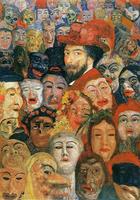
Self-Portrait with Masks
James Ensor
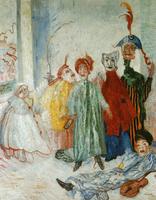
Mascaras singulares
James Ensor
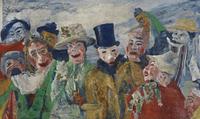
The Intrigue
James Ensor
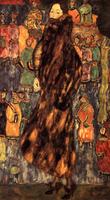
The Polecat Fur (unfinished)
Gustav Klimt
Bourgeois in a Carriage
Pavel Filonov
The great judge
James Ensor
A Ball at the Moulin de la Galette
Henri de Toulouse-Lautrec
Girl at the keyboards
Walter Gramatté
Old Woman with Masks (Theatre of Masks)
James Ensor
The Appearance of the artist's family
Marc Chagall
Danton 1789
Endre Rozsda
The Astonishment of the Mask Wouse
James Ensor
The Turkish Family
Jules Pascin
Music. Wife at the Piano
Oleksa Novakivskyi
Valloton and Misia in the Dining Room at Rue Saint-Florentin
Edouard Vuillard
Colonial Policy
Pavel Filonov
Childhood Memories, Labrenču Market
Biruta Baumane
Cabaret Scene
Salvador Dali