Expert Analysis of "I Recall The Time When My Feet Lifted Off The Ground, Ever So Slightly. – Kôrin – Chrysanthemum" by Takashi Murakami
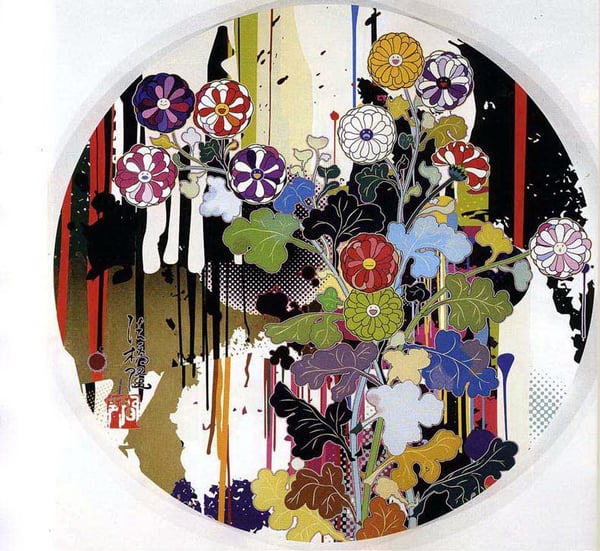
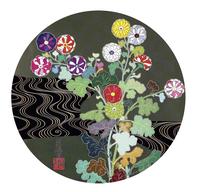
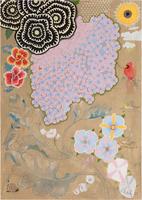
Murakami’s painting is a striking example of Neo-Pop Art’s ability to collapse historical depth into a single, dazzling image. The title directly invokes the Edo-period Rinpa master Ogata Kōrin, whose iconic gold-leaf screens of chrysanthemums and waves are transformed here through Murakami’s signature flat, hyper-saturated digital aesthetic. The chrysanthemum—a symbol of nobility, longevity, and Japan’s imperial family in traditional art—is reimagined as a radiant, cartoonish bloom, its petals rendered in bold outlines and sugary pinks that recall contemporary anime or advertising.
The floating sensation described in the title is literalized: the flower seems to hover against an abstract, atmospheric background, its roots disconnected from any ground. This levitation speaks to Murakami’s concept of the “superflat”—a flattening of both visual space and cultural hierarchy, where Kōrin’s aristocratic motifs coexist with the mass-produced imagery of post-war consumer culture. The work’s significance lies in how it performs a double appropriation: it claims the authority of classical Japanese art while simultaneously rejecting its solemnity. The result is a meditation on memory, weightlessness, and the way traditional symbols can be repurposed for a globalized, technicolor present. In this piece, Neo-Pop becomes a bridge between centuries—a chrysanthemum that blooms in the eternal now.