Expert analysis of Jacques Villon’s The Bride, After Duchamp
Style: Surrealism · Genre: cityscape
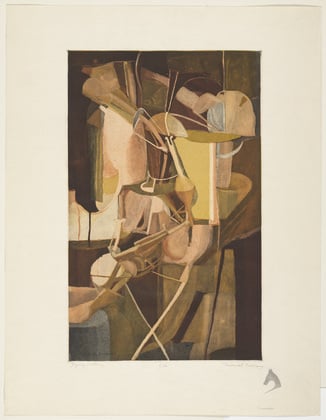
Expert Analysis: "The Bride, After Duchamp" by Jacques Villon
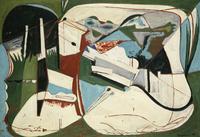
This work occupies a fascinating intersection of artistic homage and stylistic translation. Although Jacques Villon is historically celebrated as a master of Cubism (and a key member of the Puteaux Group), this piece is classified under Surrealism, revealing a later shift in his practice or a deliberate hybridization of movements. The genre is listed as a cityscape, which is particularly telling given the title’s direct reference to Marcel Duchamp’s iconic The Bride Stripped Bare by Her Bachelors, Even (also known as The Large Glass).
Significance within Surrealism and Urban Context:
-
Transposing the Bride into the City: Duchamp’s original Bride exists in an abstract, quasi-scientific “love machine” realm—a conceptual apparatus suspended in time and space. Villon recasts this figure within a recognizable urban landscape. By placing the Bride into a cityscape, Villon grounds Duchamp’s esoteric erotic mechanism in the everyday modern environment. This act suggests that the Bride is not merely a metaphysical entity but a product of the modern city—its architecture, its gears, its loneliness. The city itself becomes the “bachelor machine,” pulsing with mechanical desire.
-
Cubist-Surrealist Synthesis: Villon brings his Cubist lineage into the Surrealist domain. The fragmented planes and geometric faceting typical of his earlier work serve to dissect the urban scene and the Bride figure simultaneously. This geometric treatment creates a tension between the rational order of the city grid and the irrational, dreamlike quality of the Surrealist bride. The result is a psychological landscape where the Bride is both embedded in and alienated from the architectural environment.
-
Homage and Critique: Villon’s title, “After Duchamp,” signals a direct dialogue with perhaps the most influential work of early conceptual art. By choosing a cityscape—a genre Duchamp largely avoided—Villon critiques the purely cerebral, glass-bound nature of Duchamp’s work. He insists that the Bride must inhabit a tangible world, one of streets, rooftops, and modern flux. This makes the painting a rare Surrealist cityscape that functions as a meta-commentary on the limits of Duchampian abstraction.
-
Context of the Surrealist City: In the 1930s and 1940s, Surrealists like Salvador Dalí and René Magritte often depicted dreamlike urban spaces. Villon’s contribution is distinct: his city is not melting or overtly symbolic but structurally dislocated. The Bride appears as a ghostly presence within this lattice—simultaneously a monument, a window display, and a phantom. This ambiguity is key to the work’s Surrealist power, capturing the tension between the rational city and the irrational desires it contains.
Conclusion:
“The Bride, After Duchamp” is significant for its bold recontextualization of a seminal Surrealist concept into the urban sphere. Villon bridges Cubist structure and Surrealist imagination, creating a cityscape that is less a literal place than a psychological architecture. It stands as a rare example of an artist using the genre to interrogate the very nature of desire, modernity, and the legacy of Duchamp’s Bride, transforming her from a glass-enclosed enigma into a denizen of the streets.
Genre
Style
Visually similar
20 works with related composition and palette
Bride
Marcel Duchamp
Flagrante III
Sa Nogueira
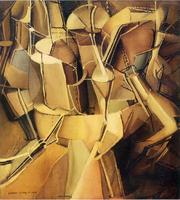
Transition of Virgin into a Bride
Marcel Duchamp
Struttura marina
Giuseppe Santomaso
Composition sur fond ardoise
Andre Lanskoy
Secretary
Willem de Kooning
Untitled
Andre Lanskoy
ORBITA CERCANA
Manuel Felguérez
Urbana #6
Richard Diebenkorn
Picture with a black arch
Wassily Kandinsky
Composition rose et parme sur fond noir
Andre Lanskoy
Still Life with Self Portrait
Carloluigi Colombo
Nude Descending a Staircase, No.2
Marcel Duchamp
L'Acrobate
Jacques Villon
Special Delivery
Willem de Kooning
Початок Сну (The beginning of a dream)
Артемій Присяжнюк
Composition sur fond rouge et noir
Andre Lanskoy
Composition
Georges Valmier
Landscape of Olympia
Yiannis Tsaroychis
Формоутворення (Forming)
Артемій Присяжнюк