Analisi esperta di The Violinist (Le violoniste Supervielle) di Jacques Villon
Stile: Post-Impressionism · Genere: portrait
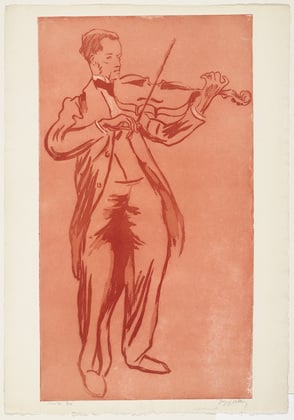
Expert Analysis: "The Violinist (Le violoniste Supervielle)" by Jacques Villon
As a Post-Impressionist portrait, Jacques Villon’s The Violinist occupies a pivotal moment in the artist’s early development, bridging the emotive colorism of the late 19th century with the structural rigor that would later define his Cubist experiments. Though Villon is best known for his role in the Section d’Or movement, this work exemplifies how Post-Impressionism allowed him to explore subjective expression through heightened chromatic intensity and simplified form.
Composition and Color
The portrait depicts a seated violinist, likely the poet and sitter Supervielle, in a domestic interior or studio. Villon employs the hallmark Post-Impressionist strategy of using color not as a mimetic tool but as a conveyor of mood and psychological depth. Warm ochers, deep blues, and raspberry reds model the figure’s face and hands, while the background vibrates with broken strokes of turquoise and mauve—a technique inherited from Seurat and Signac but loosened into more personal, expressive rhythms. The violin itself arcs like a second silhouette, its browns and golds echoing the folds of the sitter’s coat, creating a visual harmony between body and instrument.
Significance within Post-Impressionism
What makes this portrait significant is its negotiation between two competing Post-Impressionist impulses: the Symbolist desire to convey inner states and the formalist interest in geometric order. Villon avoids both the flattened synthetism of Gauguin and the pointillist rigor of Seurat. Instead, he builds the figure through a lattice of short, directional strokes—almost like the facets of an early Cubist face—while preserving the luminous atmosphere of Impressionism. The violinist’s eyes are partially shadowed, his bow hand rendered with a deliberate blur that suggests motion, not stillness. This tension between clarity and ambiguity, structure and emotion, places Villon’s work at the threshold of modernism.
Art-Historical Context
Villon painted this portrait around 1905–1908, a period when he was actively absorbing Cézanne’s volumetric planar construction and the Fauvists’ liberated palette. The Violinist thus serves as a crucial document of his transition: it retains the intimate, character-driven focus of a Post-Impressionist portrait while foreshadowing the fracturing of form that would culminate in his later Cubist works. The sitter, likely the Uruguayan poet Jules Supervielle, adds a layer of cross-disciplinary resonance—the musician as a symbol of the creative soul—that aligns Villon with the Symbolist undercurrents of the fin de siècle.
In summary, Villon’s portrait is significant for its synthesis of color symbolism, tactile brushwork, and proto-geometric structure. It is not merely a likeness but a meditation on how modern painting can capture the essence of its subject—through rhythm, hue, and the barely-stated gesture of a hand on a bow.
Visivamente simili
20 opere con composizione e palette affini
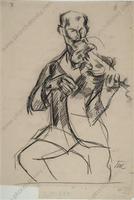
Portrait of a violinist Grigory Fedorovich Romashkov
Pyotr Konchalovsky
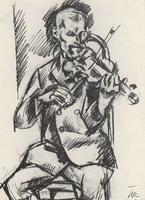
Violinist
Pyotr Konchalovsky
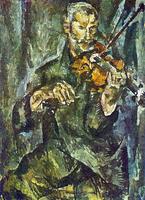
Portrait of a violinist Grigory Fedorovich Romashkov
Pyotr Konchalovsky
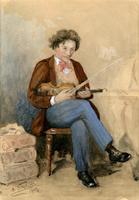
Violinist
Vladimir Makovsky
Book Cover detail - The DinksFãStan Private Collection
Johannes Meintjes
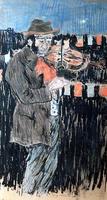
Le Violeniste
Jacques Villon
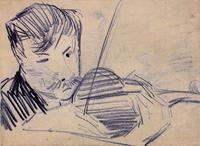
Violinist Seen from the Front
Vincent van Gogh
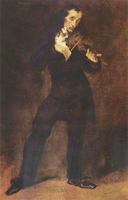
Portrait of Paganini
Eugene Delacroix
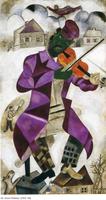
The Green Violinist
Marc Chagall
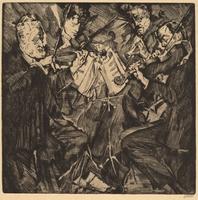
Rose Quartett
Max Oppenheimer
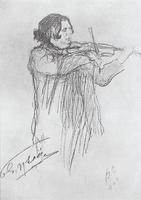
Eugene Ysaye
Valentin Serov
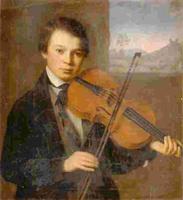
Young violin player
Cesare Tallone
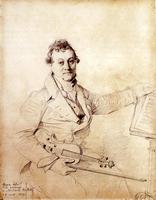
Pierre Marie François de Sales Baillot
Jean Auguste Dominique Ingres
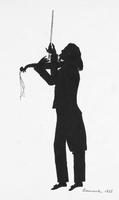
Niccolò Paganini
Auguste Edouart
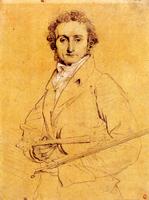
Niccolo Paganini
Jean Auguste Dominique Ingres
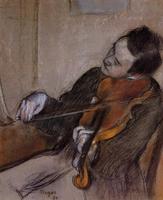
The Violist
Edgar Degas
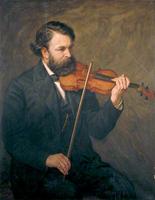
Doctor Joseph Joachim, Violinist, Conductor, Composer and Teacher
James Archer
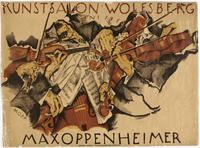
Quartet Poster
Max Oppenheimer
The Old Fiddler
James Campbell
Fiddler (study for the Jolly Flatboatmen)
George Caleb Bingham