Análisis experto de Location Piece #3(A) American Alphabet Survey de Douglas Huebler
Estilo: Cartographic Art, Conceptual Art · Género: figurative
Expert Analysis: "Location Piece #3(A) American Alphabet Survey" by Douglas Huebler
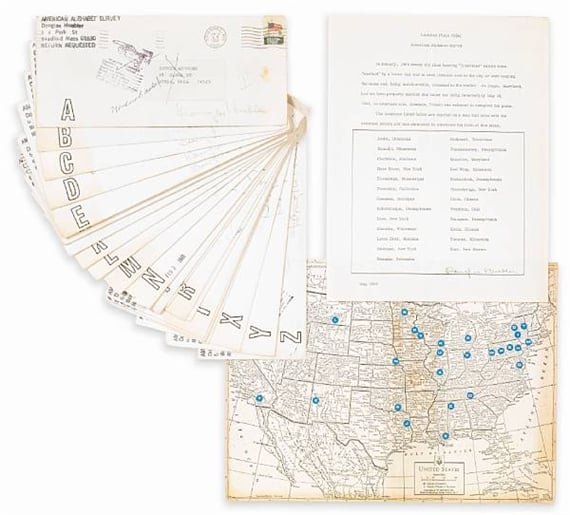
Douglas Huebler’s Location Piece #3(A) American Alphabet Survey is a seminal work that bridges Conceptual Art and Cartographic Art, redefining how we understand place, language, and representation. Executed in the late 1960s—a period when Conceptual artists prioritized ideas over traditional aesthetic objects—Huebler’s piece uses mapping as both a medium and a metaphor.
Significance within Conceptual Art:
Huebler was a leading figure in the first wave of Conceptualism, which sought to dematerialize the art object. Here, the “art” is not a painting or sculpture but a set of instructions and documentation. The work likely involves locating geographical sites corresponding to each letter of the alphabet, then recording those sites via text, maps, or photographs. This process foregrounds the concept of surveying the American landscape through an arbitrary linguistic lens, challenging the viewer to consider how language structures perception of space.
Significance within Cartographic Art:
By merging cartography with conceptual systems, Huebler transforms maps from neutral tools into subjective, even absurd, frameworks. The alphabet—a purely human invention—is imposed onto physical terrain, creating a tension between natural geography and artificial classification. This aligns with Huebler’s broader Location Pieces series, which questioned the notion of fixed meaning in location. The “figurative” genre is invoked subtly: the letters themselves are abstract forms, but their placement in real landscapes humanizes them, making the alphabet a stand-in for human cognition and communication.
Critical Legacy:
Location Piece #3(A) exemplifies how Conceptual Art can engage with pre-existing systems (maps, language) to produce new critical insights. It anticipates later practices in bio-art, data visualization, and psychogeography. Huebler’s refusal to create a conventional finished object—instead presenting a set of relational actions—cements the work’s importance as a radical rethinking of what art can be.
Visualmente similares
20 obras con composición y paleta relacionadas
List of memory
Oyvind Fahlstrom
Old coloured map of the Lorraine
Johann Homann
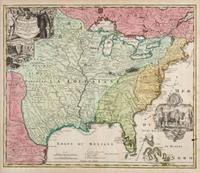
The Buffalo Map of the Mississippi River Valley
Johann Homann
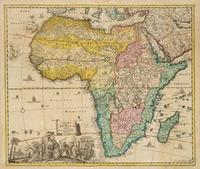
Old coloured map of the African continent
Johann Homann
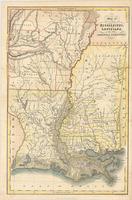
Map of the States of Mississippi, Louisiana, and the Arkansas Territory
John Hinton
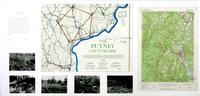
Site Sculpture Project, Windham College Pentagon, Putney, Vermont
Douglas Huebler
Maryland map
John Hinton
The World War
Max Oppenheimer
De La Gironde (région Du Sud)
Carle Vernet
Old coloured map of the Black Sea
Johann Homann
Sketch for Kidnapping Kissinger
Oyvind Fahlstrom
I Got Up at 9.47 A.M. (Feb. 12 1978)
On Kawara
The United States of Attica
Faith Ringgold
Trompe l'oeil
Denis Pierre Jean Papillon de la Ferte
Carte
Andre-Pierre Arnal
Water, Selected
Roni Horn
Map of the Saône and Loire region in France
Pierre-Paul Prud'hon
Map of Southern Russia and Ukraine
Matthaeus Seutter
Comitatus Hanau ... Solms, Budingen et Nidda cum reliqua Wetteravia
Johann Christoph Homann
Map of Luxembourg and Eastern Belgium
Matthaeus Seutter