Analisi esperta di Architektur-Entwürfe di Félix Del Marle
Stile: Neoplasticism · Genere: abstract
Expert Analysis of Architektur-Entwürfe by Félix Del Marle
Style and Context
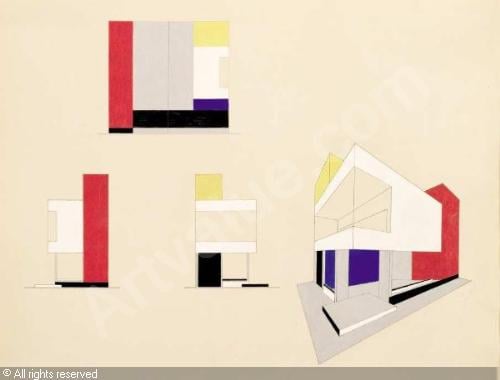
Architektur-Entwürfe (German for “Architecture Sketches”) is a work firmly rooted in Neoplasticism, the Dutch modernist movement championed by Piet Mondrian and Theo van Doesburg. Del Marle, a Belgian painter and sculptor, was an active member of the De Stijl group and one of the few artists who successfully translated Neoplastic principles from painting into architectural and spatial design. This piece, though classified as abstract, directly engages with the movement’s core ambition: to create a universal visual language based on geometric order, primary colors, and the orthogonal grid.
Formal Characteristics
True to Neoplasticism, the composition likely reduces form to horizontal and vertical lines, planes of black, white, and gray, and the primary colors (red, blue, yellow). The title Architektur-Entwürfe signals that Del Marle is not merely making a decorative abstraction but proposing a spatial, architectural logic. The work functions as a bridge between two-dimensional painting and three-dimensional environment—a key concern for Neoplasticists who sought to redesign the whole of modern life.
Significance within Neoplasticism
What makes Architektur-Entwürfe particularly significant is Del Marle’s role as a pioneer of Neoplastic architecture. While Mondrian’s paintings remained on canvas, Del Marle applied the same compositional principles to actual building designs and interior spaces. This work stands as a theoretical sketch: it demonstrates how the dynamic balance of orthogonal lines and color planes can generate not only a painting but a blueprint for an ideal, harmonious environment. In the broader De Stijl project, Del Marle’s abstractions were considered interventions into the real world—architectural art that could reshape human experience through pure, objective form.
Thus, Architektur-Entwürfe is a key document of Neoplasticism’s evolution from easel painting toward an integrated, total art—a vision of abstraction that is not only visual but spatial and constructive.
Visivamente simili
20 opere con composizione e palette affini
Sculptural Composition 'Three Russian Revolutions. 1825, 1905 and 1917'. Sketch
Vasyl Yermylov
Axonometric drawing of the house in Meudon
Theo van Doesburg
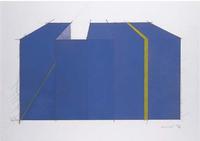
Lotto di tre opere
Rodolfo Arico
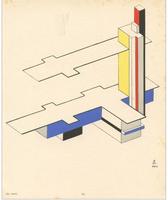
Temoignages Pour l'Art Abstrait
Félix Del Marle
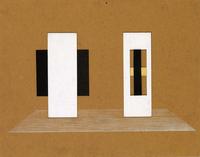
Untitled
Burgoyne Diller
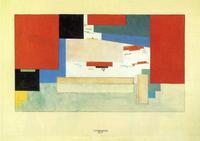
Suprematism (design for a theatre curtain, with El Lissitsky)
Kazimir Malevich
Pictorial Architecture
Lajos Kassak
Study for Rhythm of a Russian Dance
Theo van Doesburg
Formula of suprematism
Kazimir Malevich
Composition (The Cow)
Theo van Doesburg
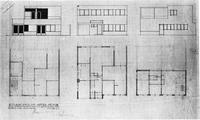
Design for a house and studio for Bertalan Pór, elevations and plans
Theo van Doesburg
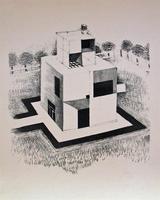
Haus Des Weissen Mannes
Johannes Itten
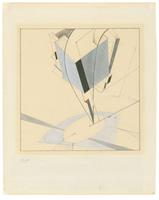
Proun 5 A
El Lissitzky
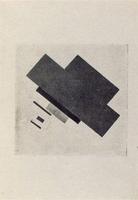
Suprematic track
Kazimir Malevich
Four Sketches to Compositions
Hryhorii Havrylenko
Villa in the City
Marcel Janco
Plans of elevations and sections of Thermopolium
Giovanni Battista Piranesi
Untitled
Camille Graeser
The principle of painting the walls
Kazimir Malevich
Proun 1 C
El Lissitzky