Description
Style: Futurism · Genre: genre painting
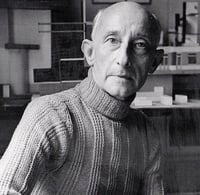
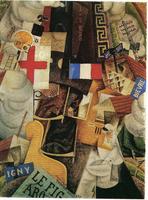
Félix Delmarle's Futurist phase lasted only three or four years, but the paintings he produced during this brief period, combined with his outspoken encouragement for a radical upheaval of artistic mores, secured him an important place in this international movement. Delmarle's Bretonnes was produced in 1913, the year he took up residence in Paris after completing his studies at the School of Fine Art in Valenciennes near Lille, and in Brussels. It was during this year also, that he became close to Apollinaire, Max Jacob and the Cubists, and shared a studio with Gino Severini. Through Severini, Delmarle became familiar with the ambitions and ideals of the Italian Futurists, becoming the only French painter to become an avowed member of their ranks and to extend upon the 'universal dynamism' expounded in their manifestos.
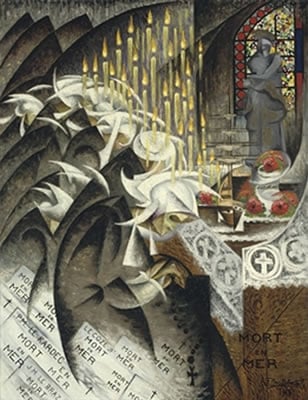
In Bretonnes, Delmarle creates a kaleidoscopic abstraction of a church interior, compressing space, time and movement into a single vision of an event. The composition follows the principles of Futurism by questioning the materiality of solid forms through fractured, multiplied planes and the use of diagonal lines to instil a sense of force and motion. The scene shows a group of women in the traditional attire of the French coastal region of Brittany, their heads bent in prayer for their sons and husbands lost at sea. The votive candles above their heads appear as a manifestation of their thoughts, and hover in the forefront of the picture plane as if they had been burnt upon the painter's retina. The influence of Delmarle's Cubist contacts can also be seen in the altar of the church, which is depicted from a multitude of angles and features a trompe l'oeil wood grain effect reminiscent of the collage works of Picasso and Braque. Although he avoids the whirl of steel and speed typical of many Futurist paintings, this unusually sombre subject embodies Delmarle's newfound mastery of prism-like distortions. This faceted space successfully integrates vignettes from an expansive environment into a cohesive and harmonious composition that represents the endless flux of objects and images through time and space.
Visually similar
20 works with related composition and palette
Family Picture
Max Beckmann
Autumn evening
Natalia Goncharova
Moses called the elders and presents Tablets of Law
Marc Chagall
Scheiber Hugó , Kabaré 1925
Scheiber Hugó
Untitled
Albert Gleizes
Scheiber Hugó, Kabaré, 1925
Scheiber Hugó
Hasidic dance during the celebration of Hanukkah
Marevna (Marie Vorobieff)
Jew at Prayer
Marc Chagall
Femmes cousant
Albert Gleizes
Illustration for Jewish folk tale 'The Goat'
El Lissitzky
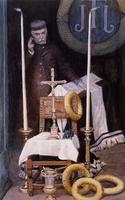
Portrait of the Pilgrim
James Tissot
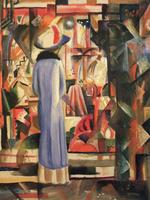
Woman in front of a large illuminated window
August Macke
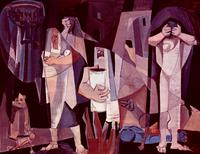
The Holocaust
Alexander Bogen
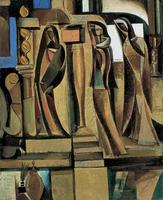
Three Veiled Figures
Wyndham Lewis
Jack be Nimble, Jack be Quick
Leonora Carrington
Girl of carnations
Amadeo de Souza-Cardoso
Dancer in a café
Jean Metzinger
Spanish Dancers
Natalia Goncharova
Train of the Wounded
Gino Severini
El Velorio
Manuel Rodríguez Lozano