Still Life
Analisi esperta di Still Life di Constantin Artachino
Stile: Impressionism · Genere: still life
Expert Analysis of "Still Life" by Constantin Artachino
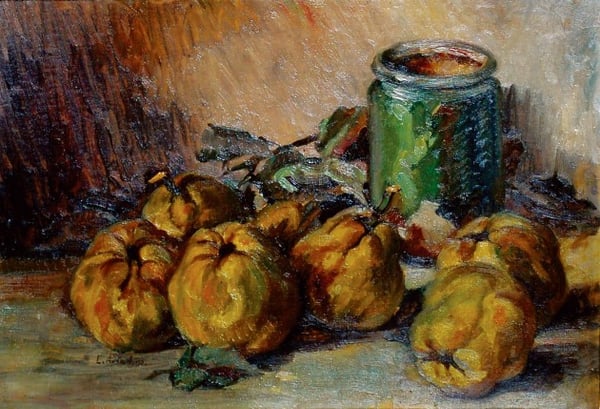
Constantin Artachino’s Still Life stands as a compelling example of how the Impressionist idiom was adapted and enriched within the Eastern European context. While the traditional still life genre often favored meticulous detail and symbolic arrangement, Artachino—like his French contemporaries—shifts the focus from object fidelity to the sensory experience of light and color.
Significance within Impressionism
-
Subversion of Genre Conventions
In academic art, still life was considered a lower genre. Impressionists, however, elevated it by treating everyday objects (fruit, flowers, tableware) as vehicles for exploring atmospheric effects. Artachino’s work likely employs rapid, broken brushstrokes that capture the fleeting play of light across surfaces—a hallmark of Impressionist technique. The composition probably avoids rigid symmetry, instead offering a “snapshot” quality that feels spontaneous rather than staged. -
Color as Structure
Where earlier still lifes relied on chiaroscuro for volume, Artachino would have modeled form through juxtaposed touches of pure pigment. Shadows are likely rendered with complementary colors (e.g., violets alongside yellows), producing optical vibrations that simulate the luminosity of an actual moment. This approach underscores the Impressionist belief that color, not line, creates form. -
Cultural Translation
As a Romanian artist working in the late 19th century, Artachino bridges Parisian innovation and local sensibility. His Still Life likely incorporates objects or textiles (embroidered cloths, ceramic vessels) that root the scene in Balkan domesticity, yet handles them with the same dissolution of contour seen in Monet’s haystacks. This synthesis makes the work significant: it proves Impressionism’s adaptability beyond France, demonstrating that its core principles—observation of transient light, valuation of perception over narrative—could thrive in a different cultural landscape.
Legacy
Artachino’s still lifes remind us that Impressionism was not a monolithic French movement but a global dialogue. By applying its liberating brushwork to intimate, everyday subjects, he asserts that the ordinary can be extraordinary when seen through an attentive, modern eye. This painting thus earns its place not merely as a decorative piece, but as a testament to the transformative power of light and the universality of Impressionist vision.
Visivamente simili
20 opere con composizione e palette affini
Still life with quinces
Pericles Pantazis
Still Life Fruit
Gustave Courbet
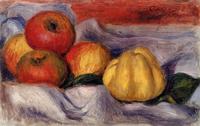
Still Life with Apples
Pierre-Auguste Renoir
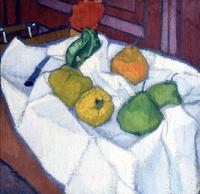
Galimberti Sándor Gyümölcs Csendélet 1906
Galimberti Sándor
Cuadros Originales
Soleto
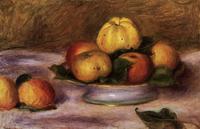
Apples and Manderines
Pierre-Auguste Renoir
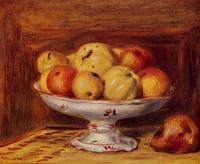
Still Life with Apples and Pears
Pierre-Auguste Renoir
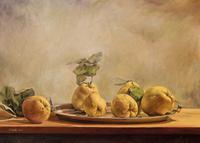
Membrillos
Soleto
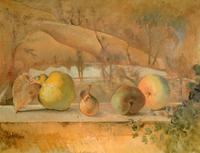
Still Life
Balthus
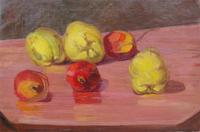
Still life
Periklis Vyzantios
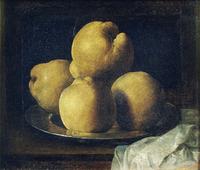
Still Life with Dish of Quince
Francisco de Zurbaran
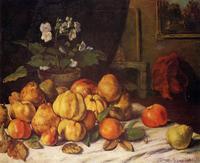
Still Life Apples, Pears and Flowers on a Table, Saint Pelagie
Gustave Courbet
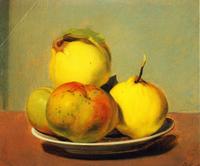
Dish of Apples and Quinces
David Johnson
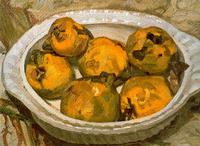
Still Life (Quinces)
Lucian Freud
Still Life with Basket of Apples
Vincent van Gogh
Still Life With Flowers And Fruit
Henri Fantin-Latour
Fruits from the agricultural exhibition
Ilya Mashkov
Apples 'Calville Blanc d'hiver'
Giovanni Boldini
Still Life with Pears and Apples
Gustave Courbet
Still life
Polychronis Lembesis