Analisi esperta di Wild Roses di Constantin Artachino
Stile: Realism · Genere: flower painting
Expert Analysis of "Wild Roses" by Constantin Artachino
Style: Realism | Genre: Flower Painting
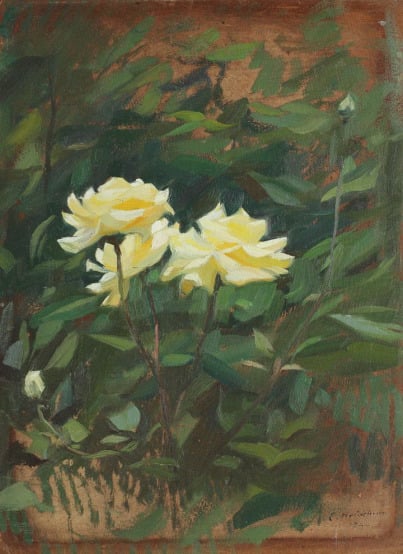
Constantin Artachino’s Wild Roses stands as a refined example of 19th-century Realist still-life painting, distinguished by its uncompromising attention to naturalistic detail and its rejection of the idealized, often theatrical floral arrangements of the Romantic era. While flower painting had long been a vehicle for symbolic or decorative beauty, Artachino anchors the genre in the Realist ethos: the faithful observation of the ordinary world.
Significance within Realism:
- Truth to Nature: Unlike the polished, symmetrical bouquets of academic tradition, Artachino’s wild roses appear as they would in the field—unfolded, slightly asymmetrical, with subtle imperfections in petal and leaf. This aligns with Gustave Courbet’s Realist manifesto to “paint things as they are,” elevating a humble, untamed subject to the dignity of serious art.
- Mastery of Light and Texture: The painting demonstrates the Realist’s dedication to capturing the precise play of light on organic surfaces. The translucency of the rose petals, the velvety softness of their folds, and the matte roughness of the leaves are rendered through careful gradations of tone, avoiding the glossy, artificial perfection of earlier still lifes.
- Atmospheric Presence: Artachino sets the flowers against a subdued, neutral background, allowing the vibrant pinks and greens to command attention without distraction. This simplicity focuses the viewer on the living, breathing quality of the plants—a hallmark of Realism’s desire to depict the ephemeral present.
Significance within Flower Painting:
- Challenging Convention: By choosing wild roses over cultivated garden varieties, Artachino subverts the traditional floral still life’s association with wealth, cultivation, and courtly symbolism. These are not hothouse blooms for an aristocrat’s table; they are a testament to the beauty found in nature’s unmediated state.
- Botanical Precision: The artist’s careful rendering of the roses’ structure—spiraling petals, serrated leaf edges, delicate stems—serves both scientific accuracy and aesthetic pleasure. This duality echoes the 19th-century tension between art and natural history, yet Artachino never sacrifices painterly sensitivity for mere documentation.
- Emotional Resonance: The wild rose is a classic emblem of fleeting beauty and vulnerability. Artachino’s treatment—fresh, vibrant, yet suggesting imminent wilting—imbues the work with a quiet, poignant realism that transcends its genre, inviting contemplation of nature’s cycles.
Legacy: As a leading figure of Romanian modern art, Artachino studied in Paris under the Realist circle and brought these principles back to the Balkans. Wild Roses exemplifies his contribution: proving that even the simplest subject—a handful of untamed blossoms—could carry the full weight of Realist authenticity, influencing subsequent generations of Eastern European still-life painters to seek truth in the everyday.
Visivamente simili
20 opere con composizione e palette affini
Small Bouquet of Roses
Constantin Artachino
Yellow Roses
Constantin Artachino
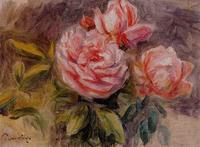
Roses
Pierre-Auguste Renoir
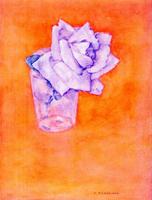
White Rose in a Glass
Piet Mondrian
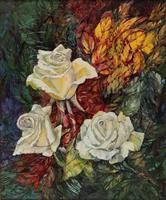
Roses II
Małgorzata Serwatka
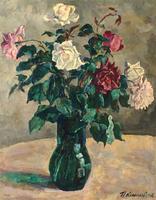
Roses in a Jug
Pyotr Konchalovsky
Roses
John Singer Sargent
Trandafiri Roz
Nina Arbore
Roses
Constantin Artachino
Roses in a glass
Pyotr Konchalovsky
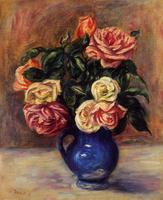
Roses in a Blue Vase
Pierre-Auguste Renoir
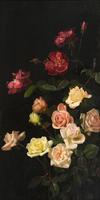
STILLLEBEN
George Cochran Lambdin
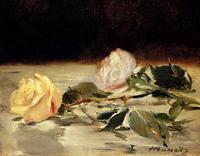
Two roses on a tablecloth
Edouard Manet
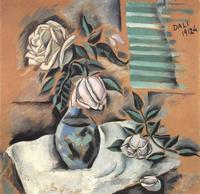
Bouquet (L'Important c'est la Rose)
Salvador Dali
Roses in a Champagne Glass
Edouard Manet
Roses III
Małgorzata Serwatka
Roses I
Małgorzata Serwatka
Roses
Hryhorii Havrylenko
Two Pink Roses
Horace Pippin
Still Life with Roses
Paul de Longpré