
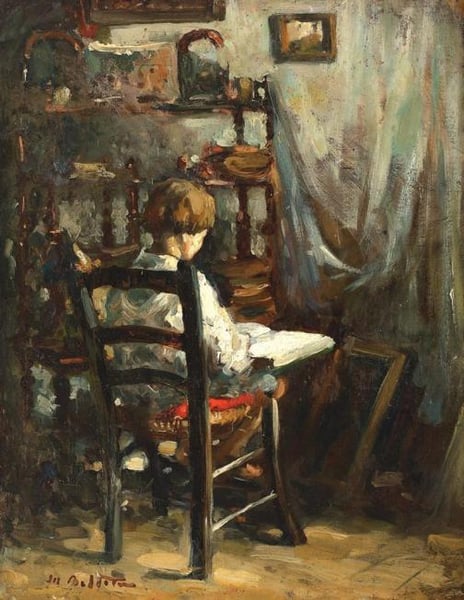
The Lesson
Analisi esperta di The Lesson di Adam Baltatu
Stile: Impressionism · Genere: genre painting
Expert Analysis of "The Lesson" by Adam Baltatu
Adam Baltatu’s The Lesson is a compelling example of how Impressionist principles were adapted to the genre painting tradition, particularly within the context of early 20th-century Romanian art. While the artwork is defined by its Impressionist style and genre painting classification, its significance lies in the synthesis of these two approaches to capture an intimate, everyday moment with both immediacy and emotional depth.
Impressionist Characteristics
As an Impressionist work, The Lesson likely emphasizes the fleeting effects of light and atmosphere. Baltatu would have employed loose, visible brushwork and a vibrant, often high-keyed palette to render the scene not as a static tableau but as a sensory experience. The focus on a single, mundane domestic or educational moment—a teacher or parent instructing a child—aligns with the Impressionist preference for modern life and casual, unposed subjects. The handling of light, perhaps streaming through a window or falling softly on figures and objects, would create a sense of temporality, suggesting that this is a snapshot of a larger narrative. This approach elevates the ordinary into something worthy of sustained contemplation, a core tenet of Impressionism.
Genre Painting Significance
As a genre painting, The Lesson participates in a long tradition of depicting scenes from daily life, but Baltatu gives it a distinctly Impressionist inflection. Rather than moralizing or idealizing the subject, he treats it with a sense of spontaneity and perceptual truth. The significance here lies in the fusion of two seemingly divergent aims: Impressionism’s emphasis on optical sensation and genre painting’s focus on human activity. Baltatu uses the informal, sketch-like technique of Impressionism to document a private, pedagogical exchange—one that resonates across cultures and time periods. The title The Lesson itself suggests a moment of instruction, but the Impressionist treatment refuses to fix a single interpretation, instead inviting the viewer to experience the textures of the room, the warmth of the light, and the quiet concentration of the figures.
Significance Within the Artist’s Oeuvre and Period
Adam Baltatu (1861–1926) was a pivotal figure in bringing Impressionist ideas to Romanian art, often blending them with national themes and genre subjects. The Lesson stands as a testament to his ability to merge local, intimate narratives with the international language of Impressionism. The work’s significance is not in grand historical or mythological allegory but in its respectful, modernist attention to the poetry of everyday life. It demonstrates how Impressionism, often associated with carefree leisure scenes in France, could be adapted to more sober, interior, and educational settings without losing its freshness or formal innovation. For the viewer, The Lesson offers a window into a specific cultural moment—the shaping of a young mind in a private, quiet space—captured with the luminous sensitivity that defines the best of Impressionist genre painting.
Genere
Stile
Visivamente simili
20 opere con composizione e palette affini
Peter I in the Palace of Monplaisir. Unfinished
Valentin Serov
Anne Reading Ouspensky, Anticoli Corrado, Italy
Frank Mason
A peasant mother and her two children in an interior
Léon Augustin Lhermitte
The Lesson
Alfred Sisley
When One is Old
William Merritt Chase
The Children
Childe Hassam
Two brothers in a study
Alfred Dehodencq
Farm Interior
Johan Hendrik Weissenbruch
In atelier
Stefan Luchian
Shoemakers
Camille Pissarro
The mother sews
Mario Sironi
Open Window
Carl Holsøe
Breakfast Time
Carl Holsøe
Interior with a Lady and a Cat
Carl Holsøe
Czóbel Béla Kékteritős Csendélet
Bela Czobel
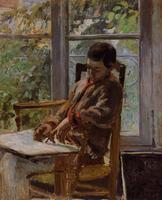
Lucien Pissarro in an Interior
Camille Pissarro
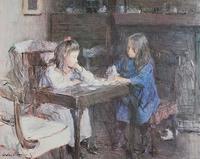
The Card Builders
Walter Osborne

Gabbro woman knitting the sock
Silvestro Lega
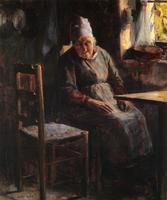
La Mere Pichaud
Guy Rose
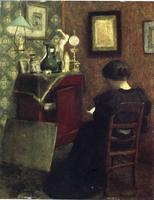
Woman Reading
Henri Matisse