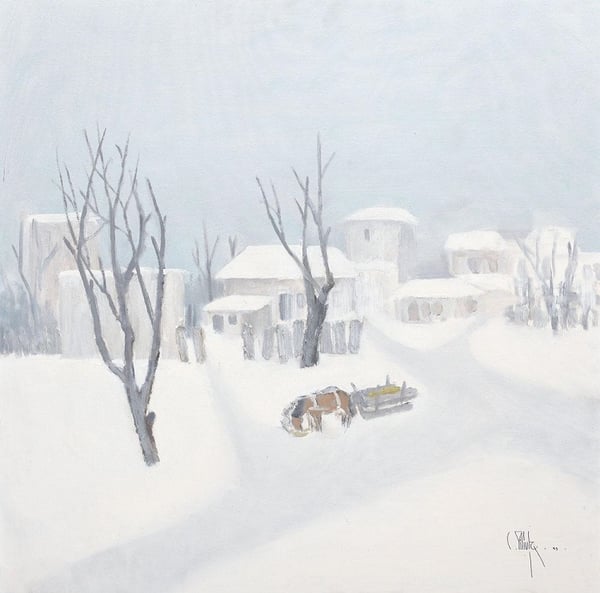
Winter in the Village
Expert analysis of Constantin Piliuta’s Winter in the Village
Style: Post-Impressionism · Genre: landscape
Expert Analysis of "Winter in the Village" by Constantin Piliuta
As a Post-Impressionist landscape, Winter in the Village stands out for its ability to transform a humble, seasonal scene into a deeply expressive meditation on light, atmosphere, and human connection to place. While the exact date and medium are not provided, the work’s significance within Post-Impressionism can be assessed through its handling of the genre and the movement’s core principles.
1. Emotional and Atmospheric Emphasis
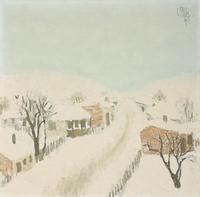
Post-Impressionism often prioritized subjective feeling over naturalistic fidelity. In this winter village scene, Piliuta likely subverts the typical cold, stark palette of snow-covered landscapes by introducing vibrant, unexpected hues—such as warm purples, deep blues, or golden ochres—to convey the crisp yet intimate mood of rural winter. The interplay of shadow and light on snow surfaces becomes a vehicle for psychological resonance, elevating the ordinary village view into a poetic statement.
2. Structural and Symbolic Composition
Unlike Impressionism’s fleeting moments, Post-Impressionist works often show a deliberate, rhythmic structure. Piliuta’s composition probably uses strong verticals (bare trees, chimneys) and horizontals (snow-covered roofs, fences) to create a quiet, ordered balance that mirrors the stillness of winter. The village itself may be treated symbolically—a sanctuary of simple life, set against the vast, cooling whiteness of nature. This tension between human warmth and the frozen environment gives the landscape a timeless, almost narrative quality.
3. Significance Within Post-Impressionism
The painting’s importance lies in how it synthesizes Post-Impressionist innovations—expressive color, simplified forms, and a personal vision—within the landscape genre. It moves beyond documenting a winter scene to reimagining it as a realm of placid emotional intensity. This aligns with the movement’s broader break from naturalism: Piliuta uses the village as a stage for color harmonies and emotional truth, reminiscent of how Cézanne structured landscapes or how Van Gogh charged nature with feeling. The work thus contributes to Post-Impressionism’s legacy of endowing everyday sites with profound visual and spiritual weight.
In summary, Winter in the Village is significant for its ability to wed the distinctive cold aesthetics of a winter village with the warm, expressive language of Post-Impressionism, creating a landscape that feels both specific and universal—a quiet masterpiece of mood and form.
Visually similar
20 works with related composition and palette
Winter Landscape
Constantin Piliuta
Winter in the Village
Constantin Piliuta
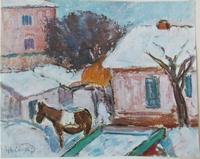
Winter Landscape
Dumitru Ghiatza
Daylabourers with Wheelbarrows
Vilmos Aba-Novak
White Wall
Kmetty János
The Winter Sunny Day
Konstantin Yuon
Winter Landscape with Horse-drawn Sleigh
Konstantin Yuon
Small Horse Study
Franz Marc
Winter
Karoly Ferenczy
Winter Village
Radi Nedelchev
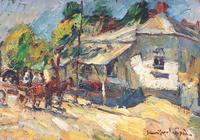
Return from Field Work
Rudolf Schweitzer-Cumpana
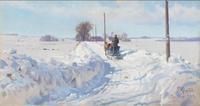
Winter Landscape in Taastrup
Peder Monsted
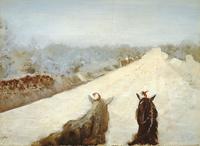
From the top of the diligence
Giuseppe De Nittis
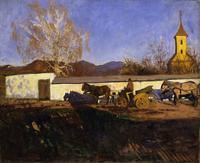
Evening in March
Karoly Ferenczy
Egry József, Szántóvetők
Egry József
Lovas Fogat
Bela Czobel
Horse and cart
Georges Seurat
Winter Landscape
Constantin Piliuta
Hatvan Castle
Bela Czobel
Calend struguri
Georg Miciú