Analisi esperta di The Harem (Sketch) di Anton Azbe
Stile: Realism · Genere: sketch and study
Analysis of "The Harem (Sketch)" by Anton Azbe
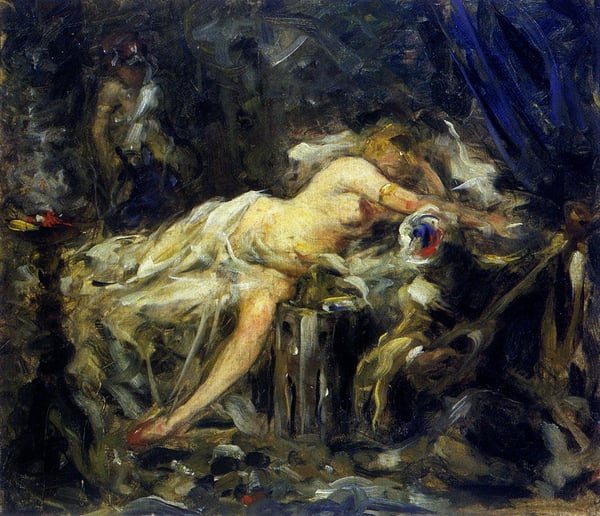
As a sketch executed in the Realist style, Anton Azbe’s The Harem (Sketch) holds significance for its embodiment of Realist principles through the very process of preparatory study. Within the Realist movement—which sought to depict contemporary life with truth and accuracy, often focusing on the everyday or the exotic “other”—this piece stands out as a raw, unpolished exploration of form, light, and composition rather than a finished narrative.
Significance within Realism:
While many Orientalist works of the 19th century presented idealized or romanticized visions of the harem, Azbe’s sketch resists such embellishment. The unfinished nature of the work aligns with Realism’s commitment to authenticity: it captures a moment of observation, not a staged tableau. The loose, gestural handling suggests the artist’s direct engagement with a live model or imaginative study, emphasizing truthful line and shadow over decorative detail. This approach demystifies the harem subject, treating it as an academic exercise in depicting the female figure and interior space rather than as a titillating fantasy.
Significance as a Sketch and Study:
The very fact that this is a sketch elevates its importance within Azbe’s oeuvre and the broader Realist tradition. Sketches were valued by Realists as windows into the artist’s working method—the raw record of visual perception before it was refined into a finished painting. Here, Azbe’s rapid strokes and unblended tones reveal his focus on capturing the fall of light on fabric and skin, the anatomy of the figures, and the spatial depth of the harem interior. This study approach demonstrates how Realist artists prioritized direct observation and technical preparation over idealization.
Artistic Context:
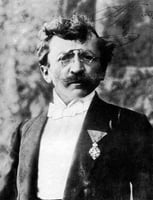
Anton Azbe (1862–1905) was a pivotal figure in the Munich School, known for his teaching and his own devotion to tonal realism. In The Harem (Sketch), we see his disciplined understanding of chiaroscuro and volumetric form—traits he passed on to pupils like Wassily Kandinsky. The sketch’s unfinished quality is not a weakness but a testament to Realism’s core value: truth to the moment of creation itself. It offers scholars a rare glimpse into Azbe’s academic process, linking Orientalist themes with the rigorous study practice that defined late-19th-century realist pedagogy.
In sum, the artwork is significant because it strips away the Orientalist veneer, presenting the harem not as a finished spectacle but as a subject for honest, skill-driven study—a hallmark of the Realist commitment to seeing and recording without artifice.
Visivamente simili
20 opere con composizione e palette affini
Nude lying down
Giovanni Boldini
Before the bullfight
Marià Fortuny
Reclining nude
Pierre-Auguste Renoir
Reclining Nude
Károly Lotz
Resting Bacchante
Joaquín Sorolla
Mother and Child
Lovis Corinth
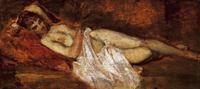
On the Sofa
Károly Lotz
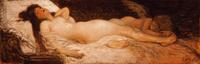
Venus and Amor
Károly Lotz
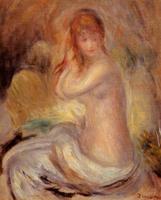
Bather
Pierre-Auguste Renoir
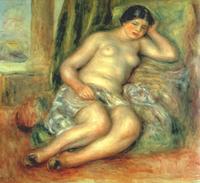
Sleeping Odalisque (Odalisque with Babouches)
Pierre-Auguste Renoir
Reclining Nude
Pierre-Auguste Renoir
Little East
Henri Fantin-Latour
Sleeping beauty
Joaquín Agrasot
Seated Nude
Pierre-Auguste Renoir
Nude in the Greenery
Pierre-Auguste Renoir
Nude
Joaquín Agrasot
Reclining female nude
Diogène Maillart
Odalisque
Eugene Delacroix
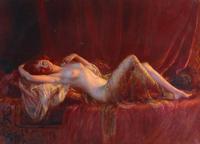
A reclining exotic beauty
Delphin Enjolras
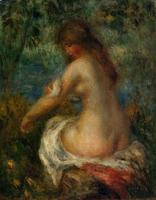
Bather
Pierre-Auguste Renoir