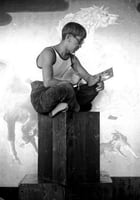
Tsuguharu Foujita sanatçısının La Vie eseri hakkında uzman analizi
Tarz: Expressionism · Tür: symbolic painting
Expert Analysis of La Vie by Tsuguharu Foujita
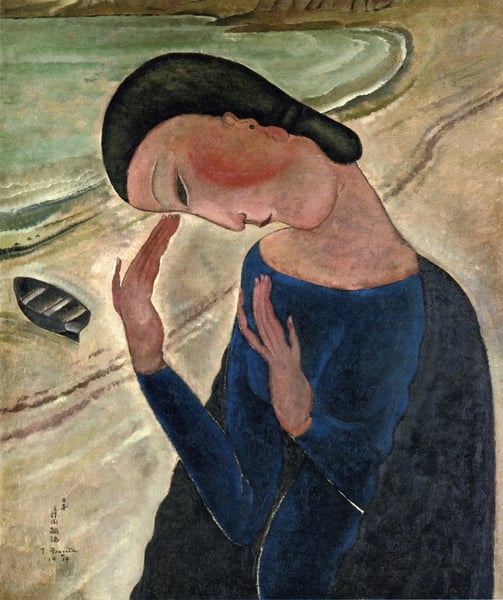
Tsuguharu Foujita’s La Vie is a significant work within the Expressionist movement, notable for its fusion of Western expressionist emotional intensity with the refined, lyrical sensibility of Japanese visual tradition. As a symbolic painting, the work transcends literal representation to explore universal themes of existence, vitality, and transience.
Significance within Expressionism and Symbolist Tradition
In the context of early 20th-century Expressionism, La Vie stands out for its distinct cross-cultural voice. While many Expressionists distorted form and color to convey inner turmoil or social critique, Foujita brought a uniquely delicate, linear quality to the style—often drawing from the ink-brush techniques of his native Japan. This hybrid approach allowed him to express raw emotion without sacrificing elegance, offering a more contemplative, less overtly aggressive take on the Expressionist impulse.
As a symbolic painting, La Vie operates on multiple levels of meaning. The title itself suggests a meditation on life’s cyclical nature, birth and death, joy and sorrow—common tropes in symbolist art. Foujita likely populated the canvas with figures or objects that serve as visual metaphors, though without specific details, the work’s power lies in how its formal elements (line, color, composition) evoke these ideas directly. The use of muted yet poignant tones, combined with fluid, almost calligraphic outlines, creates a dreamlike ambiguity that invites the viewer to project personal interpretations.
Foujita’s Unique Contribution
What makes La Vie particularly significant is how it embodies the artist’s singular position in the Parisian avant-garde. As a Japanese expatriate working in Montparnasse during the 1920s, Foujita was a celebrated figure who bridged Eastern and Western aesthetics. His work in Expressionism demonstrates that the movement was not a monolithic European phenomenon but a global dialogue. La Vie exemplifies this: it retains Expressionism’s core goal—to evoke emotion and inner experience—but achieves it through a restrained, meditative vocabulary that enriches the movement’s expressive range.
In summary, La Vie is significant as a masterwork of cross-cultural Expressionism, where symbolic ambiguity and technical refinement merge to produce a deeply personal yet universally resonant meditation on life.
Görsel olarak benzer
İlişkili kompozisyon ve renk paletine sahip 20 eser
Female Image On Landscape Background
Hryhorii Havrylenko
Woman Nursing Her Son
Salvador Dali
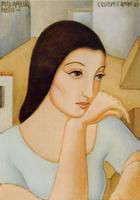
La Chica De La Azotea
Carlos Quizpez Asín
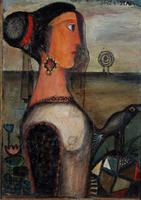
Renesansni Portret
Leonid Šejka
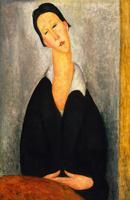
Portrait of a Polish Woman
Amedeo Modigliani
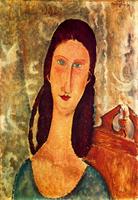
Portrait of Jeanne Hebuterne
Amedeo Modigliani
Portrait of a Woman
Amedeo Modigliani
Portrait of a Young Girl
Amedeo Modigliani
Woman with Velvet Ribbon (The Black Border)
Amedeo Modigliani
Portrait of Madame Survage
Amedeo Modigliani
Girl
Juan Gris
Soloist at Wanamaker's
Max Weber
Jeanne Hebuterne in a Hat
Amedeo Modigliani
Closed Eyes
Odilon Redon
Untitled
Antonio Bueno
A Widow
Paul Serusier
Jeanne Hebuterne with Hat and Necklace
Amedeo Modigliani
Woman's Head
Amedeo Modigliani
Marcelle
Amedeo Modigliani
Untitled
Montserrat Gudiol