Expert analysis of Nicolae Vermont’s The Red Scarf
Style: Realism · Genre: portrait
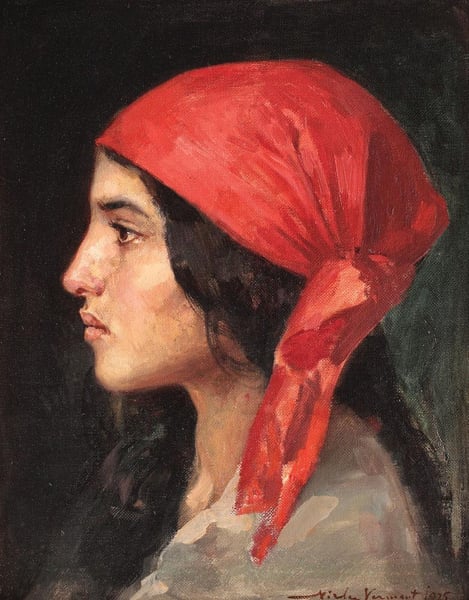
Expert Analysis of "The Red Scarf" by Nicolae Vermont
Nicolae Vermont (1866–1932) was a leading figure in Romanian Realism, and his portrait The Red Scarf exemplifies the movement’s commitment to unflinching truth and psychological depth. Painted at a time when Romanian art was transitioning from academic conventions toward a more modern, socially engaged realism, this work stands out for its quiet but powerful humanism.
What makes it significant within Realism and portraiture:
-
Psychological realism over idealization. Unlike earlier formal portraits that sought to elevate the sitter’s status, Vermont focuses on the inner life of an ordinary person—likely a worker or member of the lower middle class. The subject’s direct, slightly weary gaze, the subtle tension in the lips, and the unpretentious posture convey a lived experience, not a staged identity. This aligns with Realism’s mission to depict “real people in real situations.”
-
Mastery of tone and restraint. Vermont’s palette is subdued—earthy browns, grays, and deep shadows—except for the titular red scarf, which becomes the painting’s emotional and compositional anchor. The scarf acts as a device of focus, drawing the eye to the sitter’s face and lending a note of warmth or defiance. This controlled use of color is a hallmark of Vermont’s style, balancing naturalism with subtle symbolism.
-
Social context and dignity. In late 19th- and early 20th-century Romania, realism often carried a social message. Vermont painted laborers, peasants, and street vendors with a dignity that refused to sentimentalize or exoticize them. The Red Scarf belongs to this tradition: the sitter is neither romanticized nor pitied, but presented as a fully realized individual—a radical act in an era still dominated by aristocratic or mythological subjects.
-
Brushwork and materiality. Vermont’s technique is characterized by a soft, almost tactile handling of paint. The fabric of the scarf, the texture of the skin, and the rough background are all built with visible, expressive brushstrokes. This physical presence of paint reinforces the immediacy of the portrait, making the viewer feel they are in the same room as the sitter.
In sum, The Red Scarf is significant because it encapsulates Vermont’s contribution to Romanian Realism: a portrait that uses the language of the everyday to explore universal human presence, rendered with technical restraint and deep empathy. It advances the genre beyond mere likeness into a statement about identity, class, and the quiet power of an ordinary life.
Visually similar
20 works with related composition and palette

Head of a Young Farmer
Nicolae Grigorescu

A Girl in a Scarf
Anna Bilińska

Portrait of a Peasant Girl
Ion Andreescu

Young peasant woman with yellow shawl
Vittorio Tessari

Self-portrait
Zinaida Serebriakova

Jeanne Calvet
Jules Breton

A Russian Beauty
Alexei Harlamoff

The painter's sister
Joaquín Sorolla
Peasant woman from Gabbro
Silvestro Lega
Agnes in Red (Agnes Schleicher)
Robert Henri

Portrait of an Italian Woman
Wenzel Tornøe
Girl
Joan Brull
Head of a peasant woman
Michele Cammarano

Kobieta W Stroju Krakowskim
Leon Wyczółkowski

Self Portrait with Red Scarf
Tarsila do Amaral
ortrait de femme au foulard
Johann Victor Kramer
Tête de jeune fille
António de Carvalho da Silva Porto

Portrait of the wife
Oleksandr Bogomazov
Little Tatar Girl (Rachiș Ali)
Nicolae Tonitza
Mildred-O Hat
Robert Henri