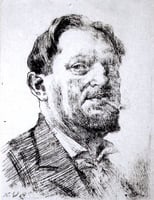
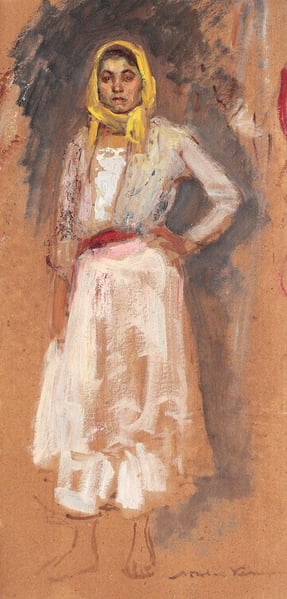
Nicolae Vermont の Gipsy Woman の専門的な分析
スタイル:Impressionism · ジャンル:portrait
Expert Art Historical Analysis: "Gipsy Woman" by Nicolae Vermont (Impressionism, Portrait)
Nicolae Vermont’s Gipsy Woman occupies a distinctive place at the intersection of late‑19th‑century Romanian Impressionism and the broader European tradition of portraiture. While Impressionism is often associated with landscapes and scenes of bourgeois leisure, Vermont applies its revolutionary formal principles—loose brushwork, vibrant color juxtapositions, and an emphasis on transient light—to a socially marginalized subject. This choice alone marks the work’s significance: it elevates a Romani woman, a figure frequently stereotyped or exoticized in academic painting, to the status of a psychologically nuanced individual deserving of the same painterly attention as any sitter.
Impressionist Technique and Portraiture
Vermont’s brushwork is characteristically broken and visible, building form through dabs and strokes of pure color rather than smooth blending. In Gipsy Woman, this technique animates the sitter’s face and clothing with a living, shimmering surface—the light seems to play across her skin and the folds of her headscarf. The palette likely moves beyond local color into subtle atmospheric effects: warm ochres, deep umbers, and touches of cool blues or violets in the shadows, a hallmark of Impressionist color theory derived from Delacroix and later the Barbizon school. Unlike more famous French Impressionist portraits (e.g., Renoir’s La Parisienne), Vermont avoids idealized prettiness; the woman’s expression is direct, perhaps even wary, capturing a fleeting psychological moment.
Significance within Romanian Impressionism
Vermont was a central figure in the Romanian artistic renaissance of the early 20th century, part of the generation that brought Impressionism from Paris to Bucharest. Gipsy Woman exemplifies how Romanian painters adapted the style to local subjects—not only urban or rural landscapes but also the diverse ethnic and social fabric of the country. Here, the portrait becomes a quiet act of realism: the “gypsy” is not a costume or a type but a person rendered with dignity and the full weight of Impressionism’s interest in ephemeral perception.
Thematic Resonance
The work also engages with the tension between modernity and tradition. The Impressionist style—an emphatically modern visual language—is used to depict a figure often seen as pre‑modern or outside of bourgeois society. This contrast imbues the portrait with a subtle social commentary: it questions who “deserves” to be painted with such luminous, democratic technique. In this sense, Gipsy Woman is both a virtuosic exercise in light and color and a quiet assertion of the humanity of a marginalized community, making it a significant—and lasting—contribution to the portrait genre and to Impressionism’s expansion beyond its original Parisian confines.
視覚的に類似
構図やパレットが近い作品 20 件
Young Girl
Romualdo Locatelli
Gipsy Woman with Red Scarf
Nicolae Vermont
Peasant Woman With Red Beads
Lucian Grigorescu
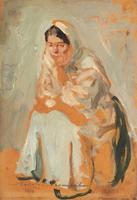
Gypsy Woman (Study)
Nicolae Vermont

Cheerful Peasant Woman
Nicolae Grigorescu

Peasant Woman
Octav Bancila
Czóbel Béla Lány Fehér Bluzban
Bela Czobel
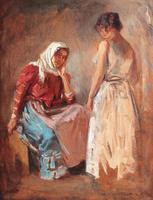
Gypsy Women Talking
Nicolae Vermont
Peasants
Martiros Sarian
Peasant Woman on Bench
Rudolf Schweitzer-Cumpana
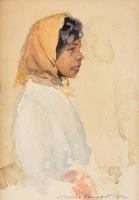
Gypsy Woman with Yellow Headscarf
Nicolae Vermont

Etude of peasant for unpreserved picture From Church
Boris Kustodiev
Young Peasant Eating an Apple
Pierre-Auguste Renoir
Woman from Bucovina
Francisc Sirato
Girl with Red Stockings
Pierre-Auguste Renoir
Girl from Pleven
Ivan Mrkviсka
Czobel Bela Lány Fehér Bluzban
Bela Czobel
Best friends
Romualdo Locatelli

Peasant Woman with Pitcher
Nicolae Grigorescu
AM5
Amos Langdown