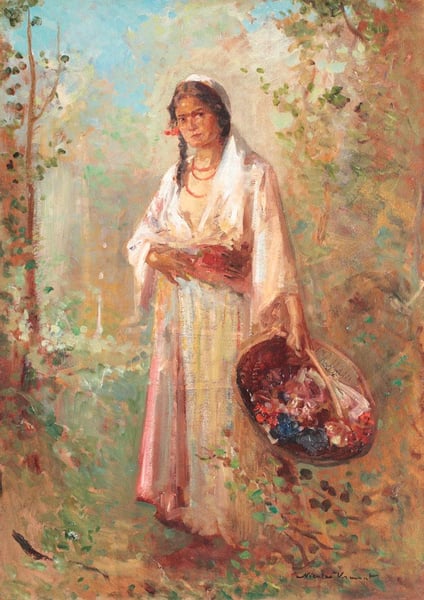
The Flower Girl
Expertenanalyse zu Nicolae Vermonts The Flower Girl
Stil: Impressionism, Realism · Genre: portrait
Expert Analysis of "The Flower Girl" by Nicolae Vermont (c. 1900s)
Nicolae Vermont (1866–1932) was a pivotal figure in Romanian modernism, and The Flower Girl encapsulates his unique synthesis of Realist social observation and Impressionist painterly technique—a fusion that made him a bridge between 19th-century academic traditions and the emerging avant-garde in Eastern Europe.
Stylistic Significance
- Realist foundation: Vermont grounds the portrait in the gritty truth of urban labor. The flower girl is not idealized; her posture, worn clothing, and downcast expression convey the quiet dignity of working-class life. This aligns with the Realist goal of depicting contemporary social realities without sentimentality.
- Impressionist treatment: The background dissolves into loose, dappled strokes of green and blue, suggesting a sunlit street without rigid detail. Light flickers across the girl’s face and the bouquet, demonstrating Vermont’s mastery of plein air atmospheric effects. The flowers themselves are rendered with rapid, broken brushstrokes that prioritize color sensation over botanical precision—a hallmark of Impressionism.
Genre and Context
As a portrait, the work goes beyond mere likeness to become a character study. Vermont positions the sitter slightly off-center, her gaze averted, as if caught mid-stride. This fleeting moment—common in Impressionist street scenes—is married to the Realist commitment to telling the stories of ordinary people. The flower basket becomes a symbol of both beauty and economic necessity.
Art-Historical Importance
Romanian art in the early 1900s was still heavily influenced by academic Neoclassicism. Vermont, along with peers like Ștefan Luchian, introduced French-inspired Impressionism to a local audience. The Flower Girl is significant because it does not simply copy Western models; it adapts Impressionist light and color to an authentically Romanian setting—a Bucharest street vendor. This hybrid approach helped define the "Romanian Impressionist" school, giving everyday folk subjects the same aesthetic weight as Parisian bourgeoisie.
Key Formal Details
- Palette: Muted earth tones (browns, ochres) anchor the composition, while small areas of high-chroma color (the yellow and red blooms) create focal points.
- Texture: Thick impasto in the bouquet contrasts with smoother blending on the girl’s face, directing attention to her weathered hands and the merchandise.
- Composition: The diagonal of the basket and the girl’s inclined head create a dynamic balance, echoing Degas’s asymmetrical portraits.
In sum, The Flower Girl stands as a testament to Vermont’s ability to merge social consciousness with optical modernity. It captures a moment of urban flux—the intersection of poverty and nature, labor and beauty—and in doing so, marks a turning point in Romanian art’s engagement with both European Impressionism and its own national identity.
Visuell ähnlich
20 Werke mit ähnlicher Komposition und Farbpalette
The Spring (Detail)
Nicolae Grigorescu
A Parisian Beggar Girl
John Singer Sargent
The Bowl of Milk
Berthe Morisot
Flower Girl
Nicolae Vermont
Woman with jug
Alejandro Cabeza
Young Woman in Red in the Fields
Pierre-Auguste Renoir

Gipsy
Konstantin Makovsky

Peasant Woman
Ipolit Strambu
The Shepherdess
Pierre-Auguste Renoir
Girl with Braids
Fedir Krychevsky
Seated Girl
George Elgar Hicks
The Garden
Abbott Handerson Thayer
In the Grove
Theodore Robinson
Italian at the fountain
Camille Corot
An Oriental beauty in a yellow scarf
Gustavo Simoni

Rosina
John Singer Sargent
Allegory of Spring
Kimon Loghi
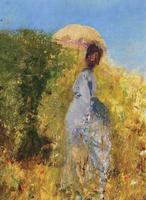
In the garden
Giuseppe De Nittis
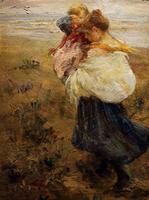
Girl with child in her arms
Alessandro Milesi
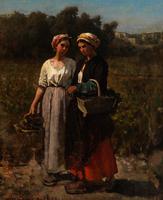
Two young woman picking grapes (Study for „The vintage at Château Lagrange“)
Jules Breton