Expertenanalyse zu Paul Pauns Lovaj
Stil: Automatic Painting · Genre: abstract
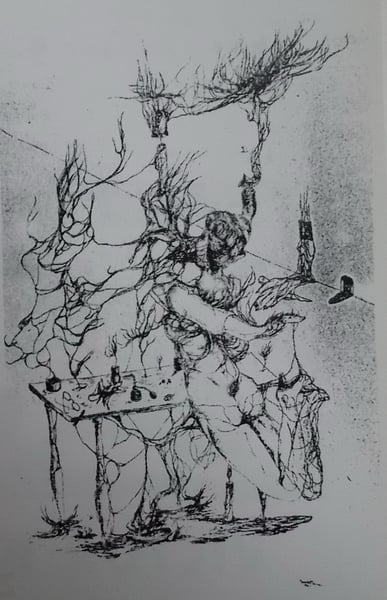
Expert Analysis: "Lovaj" by Paul Paun (Automatic Painting, Abstract)
Paul Paun’s "Lovaj" stands as a compelling testament to the radical principles of Surrealist automatism, a method championed by André Breton to bypass conscious control and channel the subconscious directly onto the canvas. Executed in the style of Automatic Painting within the abstract genre, this work embodies the core Surrealist ambition to liberate artistic creation from rational structure, logic, and premeditated composition.
Significance within Style and Period
-
Embodiment of Psychic Automatism: Automatic painting emerged in the 1920s–1940s as a visual counterpart to automatic writing. Paun, a key figure in the Romanian Surrealist movement (active within the Bucharest group alongside Gellu Naum, Victor Brauner, and others), brought a distinctly Eastern European intensity to this practice. "Lovaj" likely exemplifies the spontaneous, gestural application of paint—drips, blots, and free-flowing lines—that seeks to materialize the artist’s unguarded inner world. The absence of recognizable forms (hence "abstract") reinforces its role as a pure record of subconscious energy rather than a depiction of external reality.
-
Context of Romanian Surrealism: While French Surrealism often retained figurative elements (e.g., Dalí’s meticulous dreamscapes), Romanian practitioners like Paun pushed further into non-representational abstraction. "Lovaj" therefore marks a crucial bridge between Surrealist automatism and later mid-century gestural abstraction (e.g., Abstract Expressionism). The work’s significance lies in its early, rigorous commitment to process over product—the act of painting becomes a medium for psychic exploration, not aesthetic decoration.
-
Title and Ambiguity: The title "Lovaj" (possibly a neologism, anagram, or personal symbol) further aligns with Surrealist fascination with wordplay and the irrational. By refusing a descriptive title, Paun denies the viewer any narrative anchor, forcing engagement with pure mark-making and the unpredictable behavior of paint—a core tenet of automatic painting.
Art Historical Importance
Within the broader history of abstract art, "Lovaj" is significant as a document of Surrealist automatism’s radical potential. It demonstrates that abstraction could serve as a direct line to the unconscious, predating and influencing later movements like Art Informel and Tachisme. Paun’s work also highlights the often-overlooked contributions of the Romanian avant-garde to the development of automatic techniques, positioning him as a vital, if less widely known, innovator alongside Miró, Masson, and Pollock.
In sum, "Lovaj" is not merely an abstract composition; it is a performed act of liberation—a visual trace of the artist’s unfiltered psychic state—and a key example of how Surrealist automatism expanded the boundaries of abstraction, medium, and meaning.
Visuell ähnlich
20 Werke mit ähnlicher Komposition und Farbpalette
Untitled
Hans Bellmer
The lines of the hand
Marcel Gromaire
Untitled
Paul Paun
The Players
Conrad Marca-Relli
Untitled
Zdzislaw Beksinski
Window Towards Insomnia (2)
Vasile Kazar
Governors of Fates
Nina Tokhtaman Valetova
Untitled1
Nathan Judds
Seated Woman with Her Left Hand in Her Hair
Egon Schiele
Sitting Woman
Egon Schiele
Dali Combat
Salvador Dali
Sketchbook
Hans Bellmer
Character Assasination
David Choe
In the Realm of the Mothers III
Jenny Saville
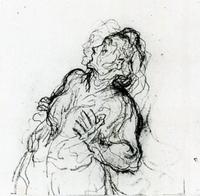
Study of a Terrified Woman
Honore Daumier
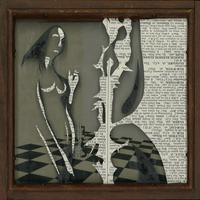
Masochistic King
Ru
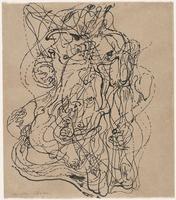
Automatic Drawing
Andre Masson
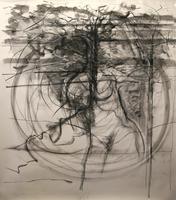
Trees No.2
Jeremy Henderson
Untitled
Hans Bellmer
Untitled
Vasile Kazar