Analisi esperta di Infra-Black Drawing di Paul Paun
Stile: Automatic Painting · Genere: abstract
Expert Analysis of Paul Paun’s “Infra-Black Drawing”
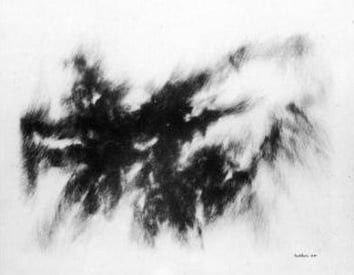
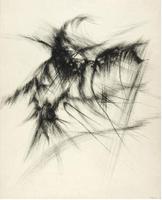
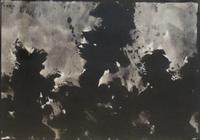
Within the realm of Automatic Painting—a Surrealist technique born from André Breton’s quest to bypass rational control and tap directly into the subconscious—Paul Paun’s Infra-Black Drawing stands as a vital, if lesser-known, contribution. Executed in the mid-20th century, the work exemplifies how automatic methods could push beyond figurative Surrealism into pure abstraction, anticipating later developments in Abstract Expressionism and Art Informel.
Key Significance in Its Style and Period:
-
Radical Use of Monochrome: The title’s “Infra-Black” signals a deliberate reduction to the darkest extremes of the palette. Paun uses black not merely as a color but as an almost perceptual limit—an “infra” (below) black that suggests depths of the unconscious where form dissolves. This prefigures the all-over black fields of artists like Pierre Soulages or the later “black paintings” of Ad Reinhardt, but through the lens of automatism rather than formalist reduction.
-
Automatism Pushed to Abstraction: While many Surrealist automatists (e.g., André Masson, Joan Miró) retained biomorphic or semi-recognizable shapes, Paun’s drawing appears to abandon figuration entirely. The gestural marks and spatters become pure energy traces—an unfiltered recording of psychic impulse. This makes the work a bridge between European Surrealist automatism and the “action painting” of the New York School, where the process itself is the content.
-
Romanian Avant-Garde Context: Paun was a core member of the Romanian Surrealist group (alongside Gellu Naum, Victor Brauner, and others). Infra-Black Drawing exemplifies their interest in “psychic automatism” as a means of political and existential liberation during the repressive post-war decades. The work’s aggressive negation of color—reducing vision to near-nothingness—can be read as an act of resistance, an attempt to see the “infra-visible” realm beyond official reality.
-
Genre as Radical Gesture: As an abstract work, it challenges the Surrealist movement’s own tension between representation and abstraction. Paun’s almost calligraphic, parsimonious marks in black on paper (likely ink or oil) create a rhythmic, allover composition that invites contemplation of the void. Its significance lies in proving that automatic drawing need not result in recognizable imagery to be psychologically potent; the very absence of image becomes the subject.
In sum, Infra-Black Drawing is significant because it pushes Surrealist automatism to its abstract extreme, anticipates later non-figurative gestural painting, and situates Paul Paun as a daring experimenter within an often-overlooked Eastern European branch of the movement. It is a work that asks the viewer to look “beyond black” into the unconscious’s undifferentiated dark.
Visivamente simili
20 opere con composizione e palette affini
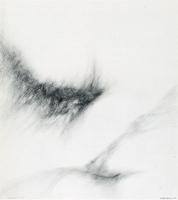
Infra-Black Drawing
Paul Paun
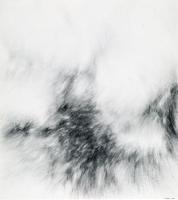
Infra-Black Drawing
Paul Paun
Untitled Vaporization
Dolfi Trost
Trees and Rain-Kingston Lisle
Norman Ackroyd
Protège-moi
Paul Paun
Untitled
M.F. Husain
The Cloud
Victor Pasmore
Emerging Beauties
Paula Klien
28 II 58
Oskar Holweck
Untitled (T1989-U11)
Hans Hartung
X-Ray Drawing 14
Joe Goode
The Mania of Revolution (Vaporization)
Dolfi Trost
Untitled Vaporization
Dolfi Trost
Infra-Black Drawing
Paul Paun
Untitled
Fernando Calhau
Composition with taches
Victor Hugo
Untitled
Henri Michaux
Machine Age Noise
Morris Graves
Untitled
Mark Tobey
Enclosed Resurgence
Julie Mehretu