Two Angels
Analisi esperta di Two Angels di Walasse Ting
Stile: Abstract Expressionism, Pop Art · Genere: figurative
Expert Art Historical Analysis: "Two Angels" by Walasse Ting
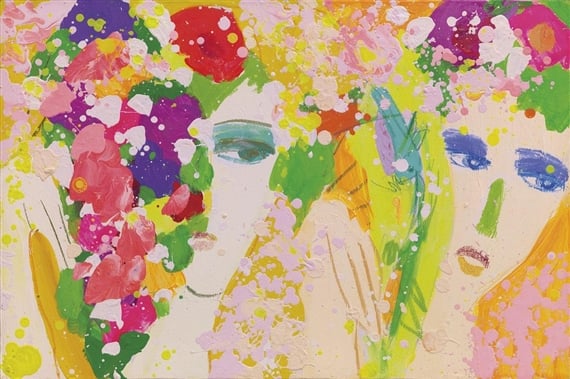
Walasse Ting’s Two Angels stands as a compelling synthesis of two major mid-20th-century movements—Abstract Expressionism and Pop Art—while remaining firmly rooted in a figurative tradition. Its significance lies in how Ting defies the boundaries between these often-contrasting styles, creating a work that is both emotionally gestural and graphically immediate.
At first glance, the painting embodies the spontaneous, energetic brushwork characteristic of Abstract Expressionism. Ting, who studied in Paris and later worked in New York, adopted the drips, splatters, and calligraphic strokes of artists like Willem de Kooning and Franz Kline. Yet unlike the purely non-objective canvases of his Abstract Expressionist peers, Ting’s composition retains recognizable subject matter: two angels. This choice bridges the movement’s focus on raw emotion with a narrative, figurative tradition—a departure that challenges the orthodoxies of mid-century abstraction.
Simultaneously, the work reflects Pop Art’s embrace of bold color, flatness, and popular imagery. Ting’s angels are rendered in vibrant, unmodulated hues—often electric pinks, vivid blues, and sunny yellows—reminiscent of comic strips, poster art, and the commercial palette of his friend Andy Warhol. The figures are simplified, nearly iconic, with thick black outlines that suggest graphic design or woodblock prints (a nod to Ting’s Chinese heritage). This duality—expressive, raw marks combined with crisp, accessible forms—makes Two Angels a seminal example of how an artist can inhabit two stylistic worlds without diluting either.
What makes the work significant within its style/period?
-
Synthesis of East and West: Ting’s Chinese roots emerge in his fluid, brush-like lines and the playful, almost calligraphic rendering of the angels’ wings and drapery. This merges with Western Abstract Expressionist gesture and Pop’s mass-media sensibilities, offering a cross-cultural dialogue rarely seen in New York School painting of the 1960s–70s.
-
Subverting Abstraction’s Dogma: At a time when Abstract Expressionism often demanded non-objectivity, Ting’s insistence on figurative angels (a traditional, even sentimental subject) injected humor, eroticism, and accessibility into a male-dominated, high-serious movement. His angels are not sacred but worldly—sometimes mischievous, often sensual—aligning with Pop Art’s democratization of imagery.
-
Color as Structure and Emotion: The vivid color fields recall Pop’s commercial vibrancy, but their application—dripped, splattered, and scumbled—retains the tactile, improvisational quality of Abstract Expressionism. This dual usage makes the canvas both a sensory explosion and a deliberate, readable narrative.
In summary, Two Angels is significant because it dissolves the false dichotomy between high abstraction and popular figuration. Ting’s work prefigures later postmodern blending of styles and remains a vital, joyful testament to an artist who refused to be confined by any single movement’s rules.
Genere
Visivamente simili
20 opere con composizione e palette affini
Two ladies with flowers
Walasse Ting
Smiling Lady
Walasse Ting
Lady in Pink
Walasse Ting
Bending Zones & Shifting Accents (Magician’s Hand II)
Gary Wragg
Where is the Mr. Ting?
Walasse Ting
Girl with Orange Hair and Flowers
Walasse Ting
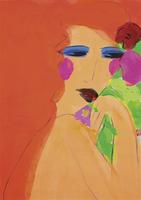
Girl with Orange Hair
Walasse Ting
Bottle, Wine Glass and Fruit Bowl
Juan Gris
Vase With Flowers and Fruit
Aldemir Martins
Les Grappes de Raisin
Seraphine Louis
Untitled
Albert Gleizes
Grapes
Martiros Sarian
Girl with Flowers
Charles Blackman
Untitled
Dimitris Mytaras
Plumen
Johannes Itten
Weizengelb
Ernst Wilhelm Nay
Vase With Flowers
Aldemir Martins
Pink Twin, Purple Twin
Walasse Ting
Figure and Flowers
Charles Blackman
Plumen
Johannes Itten