Analisi esperta di Lago-alba di Gerardo Dottori
Stile: Futurism · Genere: landscape
Expert Analysis of "Lago-alba" (Lake-Dawn) by Gerardo Dottori
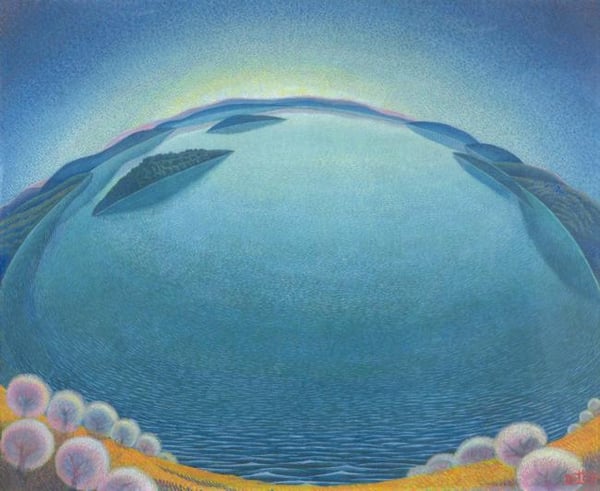
Gerardo Dottori’s Lago-alba stands as a prime example of how Futurism—often associated with the speed of machines and urban cacophony—could be harnessed to reinterpret the natural world. Painted within the context of Dottori’s mature phase, this work belongs to the subgenre of aeropittura (aerial painting), a Futurist development that sought to capture the sensation of flight and a new, transcendent view of landscape.
Significance within Futurism:
While early Futurists like Boccioni and Balla focused on the dynamic motion of people and traffic, Dottori shifted the movement's visual rhetoric toward the cosmos and nature. Lago-alba is significant because it applies core Futurist principles—simultaneity, dynamism, and the decomposition of light—to a serene subject: a lake at dawn. The painting does not depict a static view; instead, it conveys the vibrant energy of sunrise through swirling, overlapping planes of orange, violet, and aquamarine. The lake’s surface and the sky are fused into a single, pulsating field, as if the entire scene is in the act of becoming light.
Compositional Innovation:
The work likely employs a high, airborne viewpoint (typical of Dottori’s aerial aesthetic), compressing the horizon into a rhythmic sequence of hills, water, and sky. Rather than representing the lake realistically, Dottori uses simultaneity to show different moments of the dawn—the first rays, the reflection, the fading night—all at once. The brushwork is vigorous, with dashes of pure color that create a sensation of shimmering movement, echoing the Futurist fascination with the synthesis of time and space.
Lyrical Dynamism:
Lago-alba is a masterpiece of what could be called “lyrical Futurism.” It marries the movement’s violent modernism with a spiritual, almost mystical immersion in nature. This duality—the calm of a lake versus the explosive energy of light—makes the painting crucial to understanding how Futurism evolved in the 1920s and 1930s. Dottori demonstrates that the genre of landscape, far from being static, can be a vehicle for the very “universal dynamism” that Futurism championed. In Lago-alba, the dawn is not a background but an event: the entire composition is a vortex of color and form, pulling the viewer into the centrifugal force of morning light.
Visivamente simili
20 opere con composizione e palette affini
Ice and Clouds
Arthur Dove
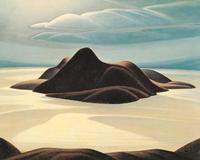
Pic Island, Lake Superior
Lawren Harris
Lake Geneva from Chexbres
Ferdinand Hodler
Aurora sul Golfo
Gerardo Dottori
Lake of Gennesaret
Nicholas Roerich
Lake Landscape
L. S. Lowry
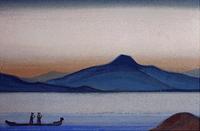
Boris and Gleb
Nicholas Roerich
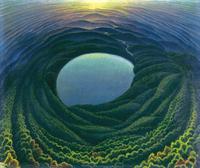
Lago umbro
Gerardo Dottori
Mountain Lake
L. S. Lowry
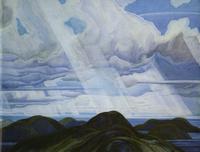
Snow Flurries, North Shore of Lake Superior
Franklin Carmichael
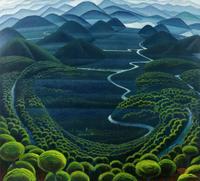
Umbria vergine
Gerardo Dottori
Himalayas
Nicholas Roerich
Fields Of Fog
Eyvind Earle
Channel Coast
Theo van Rysselberghe
Lake Superior
Lawren Harris
Seaweed Fingers
Wolf Kahn
Karelian study
Nicholas Roerich
Untitled
Vangel Naumovski
Sunset rider
Nicholas Roerich
Morocco
Nicholas Roerich