Expert analysis of Wang Guangyi’s Great Criticism – Pepsi
Style: Neo-Pop Art · Genre: advertisement
Expert Analysis: "Great Criticism – Pepsi" by Wang Guangyi
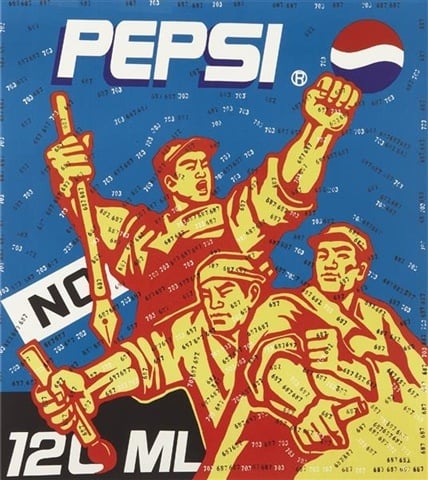
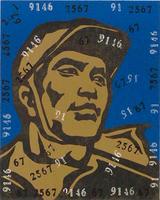
This artwork stands as a landmark of Neo-Pop Art in China, produced during the country’s rapid economic transformation of the early 1990s. Wang Guangyi’s Great Criticism series—of which this Pepsi variant is a prime example—is celebrated for its synthetic juxtaposition of Socialist Realist imagery with Western corporate branding.
Formal and Compositional Strategy
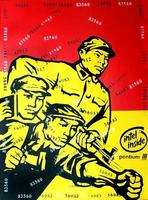
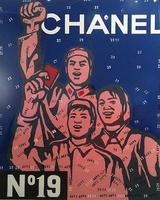
The painting adopts the visual language of Chinese Cultural Revolution propaganda: heroic workers, peasants, and soldiers are depicted in bold, flat colors with idealized features, derived from iconic posters of the Mao era. However, the customary revolutionary slogans or political symbols are replaced by the Pepsi logo and its red, white, and blue color scheme. This deliberate substitution creates a jarring, ironic clash between the serious, collectivist iconography of communism and the seductive, individualistic promise of global consumerism.
Significance in Art Historical Context
- Critique of Ideological Commodification: Wang directly critiques how post-Mao China’s market reforms transformed Marxist propaganda into a tool for selling capitalist products. The workers’ stern expressions, originally meant to inspire revolutionary zeal, now seem to endorse or be co-opted by a foreign soft-drink brand, suggesting that consumer culture has become the new state religion.
- Neo-Pop and Political Pop: Alongside artists like Andy Warhol (Western Pop’s celebration of commercial imagery) and contemporaries such as Yu Youhan, Wang helped define Political Pop, a sub-movement that merged Pop art’s mass-media aesthetics with Chinese political critique. Great Criticism – Pepsi epitomizes this by using advertising techniques to deconstruct both Communist propaganda and Western corporate hegemony.
- Global-Local Tension: The work resonates with China’s “opening up” policy, reflecting anxieties about cultural authenticity, identity, and the erasure of socialist history under the tide of globalization. The Pepsi logo becomes a symbol of both aspiration and contamination.
Legacy
Wang Guangyi’s Great Criticism series remains one of the most incisive visual commentaries on the hybrid ideology of post-socialist China. Great Criticism – Pepsi in particular has been exhibited worldwide as a touchstone for understanding how Neo-Pop art can interrogate the collision of political and commercial iconography. Its significance lies not merely in its stylistic appropriation, but in its unflinching exposure of the paradoxical coexistence of revolutionary memory and capitalist desire.
Genre
Style
Visually similar
20 works with related composition and palette
Coca-Cola
Wang Guangyi
Great Criticism – No Time
Wang Guangyi
Intel
Wang Guangyi
Materialist’s Art
Wang Guangyi
Album cover 'The artists are on the war in Spain'
Arturo Souto
Chanel no. 19
Wang Guangyi
Scientific Sowing Will Yield a People's Harvest
Valerii Lamakh
The Belief
Wang Guangyi
Soviet Science is in a Glorious Orbit, Science Worthy of the People — the Creator
Valerii Lamakh
Berény Róbert , Fegyverbe 1919
Berény Róbert
Labor
Boris Kustodiev
Poster Leningrad Department of State Publishing (Lengiz)
Boris Kustodiev
We Glorify the Motherland with Our Work
Valerii Lamakh
Splendidly and desperately do we fight — the issue of Suvorov and Chapayev do it all right!
Kukryniksy
Peoples of the USSR before and now (old and new life in Central Asia)
Boris Kustodiev
Prelude to a Million Years
Lynd Ward
For the Benefit of the People
Valerii Lamakh
Advertising Poster. Read magazine 'Molodaya Gvardiya'
Alexander Rodchenko
Promotional poster for the newspaper "Morning of Russia"
Eugene Lanceray
"I HAVE AN AX, AN AX…"
Georgyi Yakutovytch