Description
Style: Abstract Art · Genre: abstract
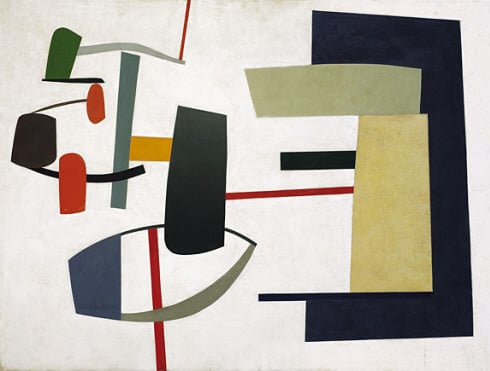
Between 1932 and 1935 Jean Hélion created a series of paintings exploring states of visual equilibrium. Among the earliest of these is Equilibrium (Collection Mr. and Mrs. Roy Friedman, Chicago), a simple composition of 1932 in which two curved rectangular shapes are held in balance by two slightly curved lines. In his working journal Hélion recorded the following observations about this work: “In searching for the effect of space and movement on the elements, that is to say in constructing a work in movement, rather in creating equilibrium out of movement, my images have become more pliant. . . . To establish relations between surfaces as complex as those which are defined by curves, it is necessary to arrange nuances.”
Following this initial experimentation, Hélion composed several variations on the theme of equilibrium. Generally he worked with drawings and oil studies before reaching the formal solutions of his large canvases. His concern in the present work is to establish a balance between the blocky, simple, essentially rectangular mass on the right with the more complex, more colorful, and varied forms on the left. The construction on the left, which is composed of overlapping and interpenetrating curves, bars, and lines, is not continuous. Careful inspection reveals that the unit of four elements in the upper left corner (the red, gray, and black bars and the green shape) does not touch the forms immediately below it. A similarly strategic use of discontinuous forms occurs in other works in the Equilibrium series. In the present painting the subtly disconnected arrangement contributes to the sense of movement and dispersion of the left side of the composition. The multiple hues used at the left also generate visual complexity. The horizontal curves on the left all point to the central white void, which is embraced by the more rigidly horizontal dark blue and light green arms of the stable construction on the right. Vibrant red and orange bars unite the edges of the composition with central forms and bind together right and left halves. A state of visual balance is thus achieved without resorting to the purely rectilinear, often programmatic formulations of the De Stijl artists who had influenced Hélion. The Equilibrium series, embodying ideas of suspension and tension of two-dimensional forms, inspired Alexander Calder, who was contemporaneously developing his wind-driven mobiles. (Elizabeth C. Childs)
Museum / Gallery
Visually similar
20 works with related composition and palette
Organization
Arshile Gorky
Study for the Hall of Medical Sciences mural at the 1939 World's Fair in New York
Ilya Bolotowsky
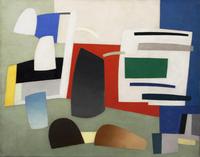
Composition
Jean Helion
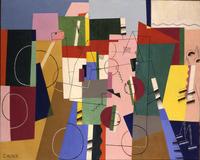
Landscape
Georges Valmier
Feb 28-53 (vertical seconds)
Ben Nicholson
Untitled
Mario Ballocco
Abstract 2
René Marcil
The Nautical Land
Balcomb Greene
Repercussion 4
Alberto Magnelli
Untitled (N.Y. World's Fair)
Ad Reinhardt
Whiplash
Will Barnet
Composition
Georges Valmier
The disc and lid
Alexander Rodchenko
Ile de France
Jean Helion
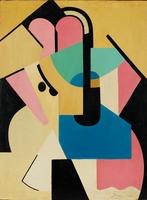
Abstract Composition No. 6
Marthe Donas
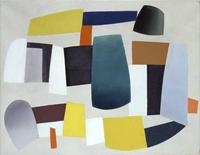
Abstract Composition
Jean Helion
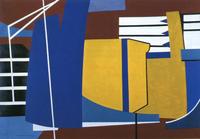
Nacelles Under Construction
Ralston Crawford
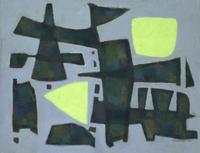
-12°
Alfred Manessier
The Sculptor
Willi Baumeister
Bortnyik Sándor, Kompozició
Sandor Bortnyik