Expert analysis of Helene Schjerfbeck’s Girl from Eydtkuhnen II
Style: Expressionism · Genre: portrait
Expert Analysis: "Girl from Eydtkuhnen II" by Helene Schjerfbeck
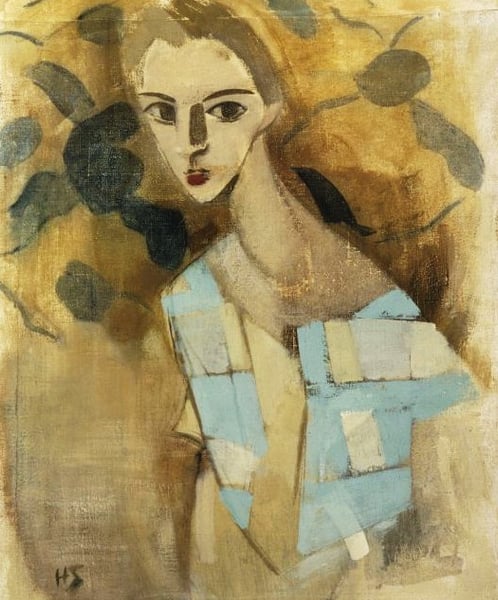
Helene Schjerfbeck’s Girl from Eydtkuhnen II is a striking example of how Expressionist portraiture can distill human presence to its psychological and emotional essence. Painted during the artist’s late, most radical phase, the work embodies the shift from descriptive realism toward a raw, introspective Modernism that defines Schjerfbeck’s mature voice.
Significance within Expressionism:
Unlike the more overtly dramatic German Expressionist works of the same period, Schjerfbeck’s approach is subdued yet piercing. The portrait strips away incidental detail—the girl’s features are simplified, the palette reduced to muted, almost chalky earth tones and greys. The face appears slightly flattened, with hesitant contours and a gaze that seems both watchful and withdrawn. This tension between fragility and presence is quintessential to Schjerfbeck’s expression: not the external scream of angst, but the quiet, insistent truth of a subject’s inner life.
Genre and Context:
The “Girl from Eydtkuhnen” series (based on a model from a small East Prussian town) allowed Schjerfbeck to explore repetition and variation—a hallmark of her later decades. In II, the sitter’s identity is less important than the mood she evokes: a melancholy resilience, a sense of being caught between vulnerability and strength. The brushwork is deliberately rough, sometimes dry, exposing the canvas and creating a surface that feels almost scarred. This technique mirrors the emotional weight carried by the girl, making the painting itself an artifact of feeling.
Legacy:
Schjerfbeck’s work is significant for proving that Expressionism need not be loud or colorful to be powerful. Her portraits, especially after the 1920s, anticipate the stark psychological realism of later 20th-century painting. Girl from Eydtkuhnen II stands as a testament to how a single figure, rendered with restraint and honesty, can embody the entire existential condition of modern solitude.
Visually similar
20 works with related composition and palette
The Teacher
Helene Schjerfbeck
The Fortune-Teller (Woman in Yellow Dress)
Helene Schjerfbeck
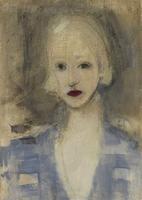
Blond Woman
Helene Schjerfbeck
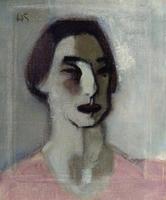
Forty Year Old
Helene Schjerfbeck
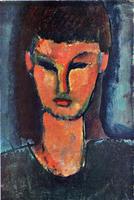
Young Woman
Amedeo Modigliani
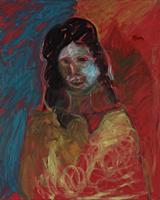
Mirella
Tano Festa
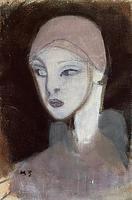
Girl From the Islands
Helene Schjerfbeck
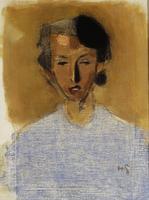
Portrait of a Girl in Blue and Brown (Inez)
Helene Schjerfbeck
Kondor Béla, Női Fej,.
Kondor Béla
Kondor Béla, Női Fej,.
Kondor Béla
Woman with White Coat
Amedeo Modigliani
Anna Margit, Egymás Mellett 1937
Anna Margit
Untitled
Ligia Macovei
Modok Mária, Női Portré 1940
Modok Mária
Rózsaszin Ruhás Lány
Bela Czobel
Girl from Loviisa
Helene Schjerfbeck
Anna Margit , Két Nő Boritékkal(önarckép) 1937
Anna Margit
Jeanne Hebuterne with white collar
Amedeo Modigliani
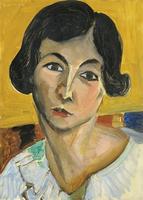
Tête De Femme Penchée (Lorette)
Henri Matisse
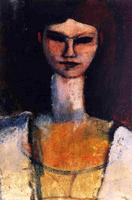
Bust of a Young Woman
Amedeo Modigliani