
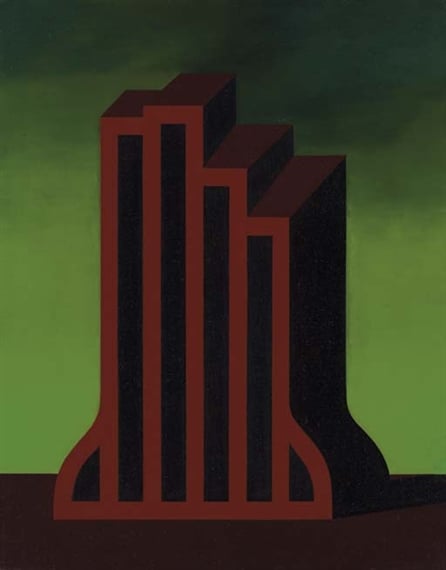
Monumento
Roberto Aizenberg の Monumento の専門的な分析
スタイル:Hard Edge Painting, Metaphysical art · ジャンル:figurative
Expert Analysis of Monumento by Roberto Aizenberg
Roberto Aizenberg’s Monumento stands as a compelling synthesis of two seemingly divergent movements—Hard Edge Painting and Metaphysical art—channeled through a distinctly figurative lens. The work’s significance lies in how it marries the uncompromising geometric clarity of Hard Edge abstraction with the enigmatic, dreamlike stillness of Metaphysical painting, producing an image that is both formally rigorous and psychologically charged.
Stylistic Hybridity
Hard Edge Painting (emerging in the late 1950s–60s) is defined by crisp, sharp-edged forms, flat color fields, and an emphasis on pure opticality. Aizenberg adapts this vocabulary not for abstract ends but to render a figurative subject—a solitary, monolithic monument—with extreme precision. The structure’s contours are razor-sharp, its surfaces unmodulated, and its shadows rendered as clean, hard-edged planes. This eliminates the romanticism of painterly brushwork, instead creating an almost architectural exactitude that pushes the image toward an eerie hyper-realism.
Simultaneously, the work belongs to the Metaphysical tradition (revived from Giorgio de Chirico’s early 20th-century piazzas). The monument is isolated in an ambiguous, barren space under a uniform, airless sky; the time of day is indeterminate, the atmosphere suspended. Aizenberg evokes de Chirico’s uncanny juxtaposition of ordinary objects rendered strange through isolation and precise geometry. Yet he replaces de Chirico’s classical arcades and statues with a stark, faceless modern tower—a “monument” stripped of historical reference, signifying only its own mute presence.
Significance within Its Period
- Uniting abstraction with figuration: In the 1960s–70s, Hard Edge was largely a non-representational movement (e.g., Ellsworth Kelly, Kenneth Noland). Aizenberg subverts this by applying Hard Edge’s crisp formalism to a figurative, narrative-adjacent scene. This hybridity anticipates later trends of “postmodern surrealism” and retro-futurist imagery.
- Revitalizing Metaphysical art: By the mid-20th century, Metaphysical painting had largely faded. Aizenberg reanimates its eerie stillness through contemporary geometric exactitude, demonstrating that the metaphysical impulse—a sense of suspended time and unexplained solitude—could be achieved without nostalgic classicism.
- Latin American modernist voice: Aizenberg, an Argentine artist, brings a personal, introspective quality to these international styles. His monuments often carry an autobiographical weight—a sense of loss or alienation—that transcends pure formalism, aligning with the Latin American tendency to infuse geometric art with existential or social meaning.
What Makes Monumento Enduring
The painting’s power resides in its deliberate contradiction: a hard, unyielding object rendered with absolute clarity, yet radiating an underlying melancholy and mystery. The monument is both a geometric exercise and a silent protagonist in a haunted stage. Viewers are left to question its purpose—memorial? warning? relic?—while being held at arm’s length by the work’s cool, impassive execution. This tension between formal control and emotional ambiguity marks Aizenberg’s unique contribution, making Monumento a touchstone for those exploring the intersection of abstraction, figuration, and metaphysical unease.
視覚的に類似
構図やパレットが近い作品 20 件
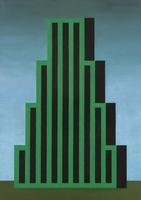
Tower
Roberto Aizenberg
Tower
Roberto Aizenberg
Painting
Roberto Aizenberg

Painting
Roberto Aizenberg
Composition (Design for Today)
Paul Nash
Library in the House of da Silva (set design for Uriel Acosta)
Nathan Altman
Tower
Roberto Aizenberg
A storm
Rene Magritte
Diagonal Planes
Frantisek Kupka

Haven - Opus 2
Victor Servranckx
Two grays I
Frantisek Kupka
Introspection
Goran Djurovic
Downwards
Wassily Kandinsky
Mechano-Faktura Construction
Henryk Berlewi
Drop
Richard Smith
Portalerna
Sven Jonson
Composition V
Michel Seuphor
Untitled
Donald Judd
Waiting (from the Oniro series)
Vasile Dobrian

Painting
Roberto Aizenberg