Expert analysis of Gregoire Boonzaier’s Trees
Style: Post-Impressionism · Genre: landscape
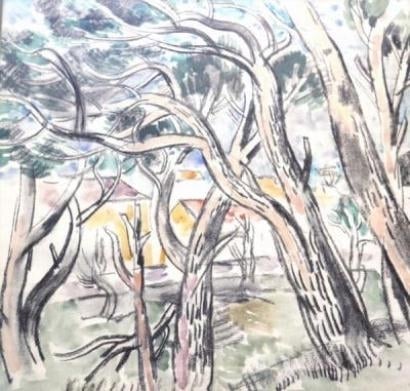
Expert Analysis of "Trees" by Gregoire Boonzaier
As a Post-Impressionist landscape, Trees exemplifies the movement’s decisive shift away from naturalistic representation toward a more subjective, emotionally charged vision. Boonzaier’s work is significant within this style for its deliberate emphasis on structure and color as vehicles of expression. Rather than merely documenting the scene, the artist likely transforms the trees into bold, rhythmic forms—simplifying branches and foliage into geometric or sweeping shapes that convey the underlying energy of the living landscape. The palette would be heightened beyond literal observation, using intensified greens, earth tones, and contrasting accents to evoke a particular mood or atmosphere. This approach aligns with the Post-Impressionist belief that art should communicate the artist’s personal response to nature, not just its outward appearance. In the context of Boonzaier’s career, Trees stands as a testament to the enduring power of the genre to capture both the physical presence and the spiritual resonance of the natural world, making it a notable contribution to the South African Post-Impressionist tradition.
Visually similar
20 works with related composition and palette
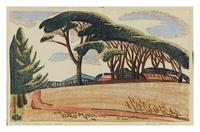
The Windswept Farm
Dorrit Black
Nude Sitting
Bela Czobel
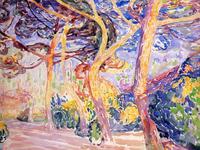
Under the Pines
Henri-Edmond Cross
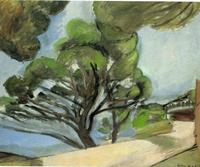
Untitled
Henri Matisse
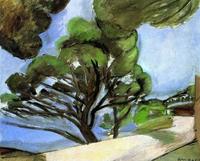
The Large Pine
Henri Matisse
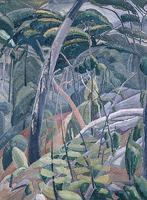
The gully
Grace Cossington Smith
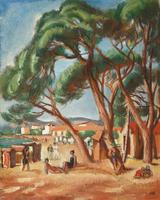
Southern France Beach
Iosif Iser
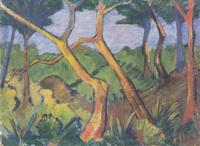
Waldlandschaft
Otto Mueller
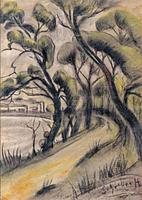
Scheiber Hugó Kanyargós Út,
Scheiber Hugó
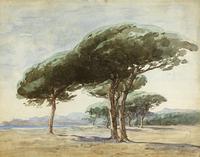
STONE PINES
Nathaniel Hone the Younger
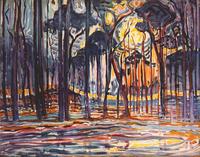
Woods near Oele
Piet Mondrian
Scene from Lebanon
Mahmoud Saiid
Big Pine
Ivan Bilibin
Pine Trees in Front of the Wall of the Asylum
Vincent van Gogh
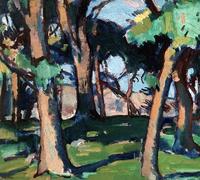
Douglas Hall
Samuel Peploe
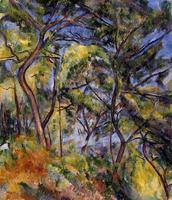
Forest
Paul Cezanne
Towards Castellonorato
Antonio Sicurezza
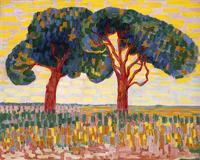
Twee bomen, olieverf op doek
Jacoba van Heemskerck
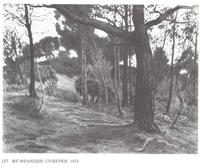
South of France. Twilight
Ivan Bilibin
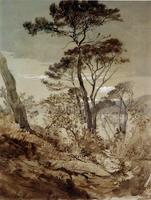
Stone Pines at Sestri
John Ruskin