Analisi esperta di Basoth woman with headdress di George Pemba
Stile: Social Realism · Genere: portrait
Expert Analysis: Basoth Woman with Headdress by George Pemba
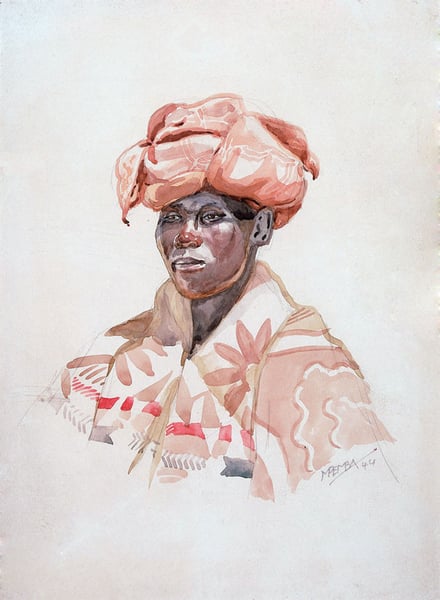
George Pemba’s Basoth Woman with Headdress is a compelling example of Social Realist portraiture, created within the fraught cultural and political landscape of mid-20th-century South Africa. Strictly adhering to the known facts—style: Social Realism; genre: portrait—the work’s significance lies in how it uses the conventions of realist depiction to assert the dignity, specificity, and humanity of a subject historically marginalized under apartheid.
Art Historical Context and Stylistic Significance
As a Social Realist work, Pemba’s portrait moves beyond mere likeness to serve a documentary and moral purpose. Social Realism in South Africa during Pemba’s most active years (1930s–1960s) was a deliberate counter-narrative to both colonial ethnographic stereotypes and the abstract modernism favored by white art institutions. Pemba, trained at the South African Native College (Fort Hare) and later through correspondence with the Slade School of Fine Art, adopted a naturalistic technique—precise modeling of form, controlled chiaroscuro, and a muted yet warm palette—to lend gravitas to everyday subjects. Here, the woman’s steady gaze, the careful rendering of her facial features, and the textured representation of her traditional Basotho headdress (the mokorotlo, a conical straw hat distinctive to the Basotho people) all signal that this is not a generic “native type” but a specific, named individual worthy of artistic attention.
Cultural and Political Resonance
Pemba’s choice to focus on a Basotho woman—complete with a culturally specific headdress that denotes ethnic pride and identity—was itself a radical act. Under the segregationist policies of the time, black South Africans were often rendered invisible or reduced to laboring bodies in art. By centering a woman in ceremonial headwear, Pemba emphasizes cultural continuity and self-possession. The headdress functions as both a formal anchor (its conical shape balancing the composition) and a symbol of indigenous resilience. This aligns perfectly with Social Realism’s core tenet: to reveal the social conditions and inner lives of ordinary people, often those oppressed by systemic injustice.
Significance Within Pemba’s Oeuvre and the Period
George Pemba is hailed as one of the “pioneers of South African Black art,” alongside Gerard Sekoto. Basoth Woman with Headdress exemplifies his mature style: a fusion of European academic realism with an unflinching commitment to portraying black South Africans with empathy and authenticity. Unlike the more expressionistic works of some contemporaries, Pemba’s restraint allows the subject’s quiet strength to speak volumes. The portrait thus serves as a historical document—preserving the visage and attire of a Basotho woman in an era when such images were systematically erased—and an aesthetic statement that elevates humble portraiture to social commentary. In doing so, Pemba not only claimed space for black subjects in fine art but also refused the victim narrative, offering instead a vision of pride and composure that resonates powerfully within the Social Realist tradition.
Visivamente simili
20 opere con composizione e palette affini
Mother with baby
George Pemba
Xhosa mother and child
George Pemba
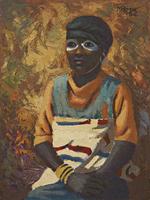
Xhosa woman
George Pemba
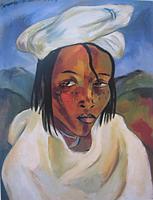
Portrait of a Pondo Woman
Irma Stern
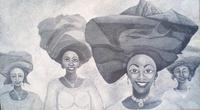
Gele (Head tie)
Olusola David, Ayibiowu
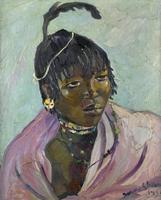
Portrait of a young Mpondo
Irma Stern
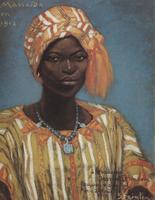
Massaida
Theophile Steinlen
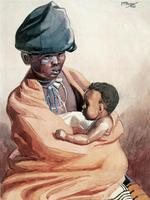
Mother and child
George Pemba
Portrait de jeune enfant
Jules Charles Clement Taupin
Portrait of a North African Lady
Cesare Biseo
Randja
Jules Charles Clement Taupin
Hopi with Manta
T. C. Cannon
Traditional Xhosa woman
George Pemba
NOIR SOUVENIR
Jules Charles Clement Taupin
WOMEN AND CHILD, EASTWOOD, PRETORIA
Gerard Sekoto
Moroccan women
Zinaida Serebriakova
Xhosa woman smoking a pipe
George Pemba
Cloud Madonna
T. C. Cannon
Two naitives from Guinea
Mariam Aslamazian
Young Fellah
Nasreddine Dinet