
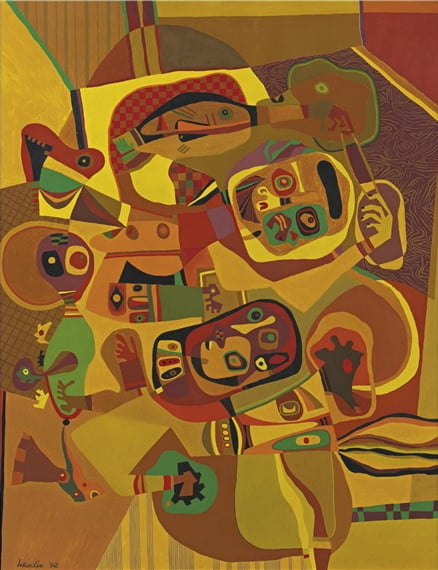
The Gold Cord
Expert analysis of Steve Wheeler’s The Gold Cord
Style: Indian Space painting · Genre: abstract
Expert Analysis of "The Gold Cord" by Steve Wheeler
Steve Wheeler’s “The Gold Cord” is a seminal work within the Indian Space painting movement, a mid‑20th‑century American abstract style that drew heavily on the geometric and symbolic vocabularies of Indigenous North American art. As an abstract piece, the painting eschews representational imagery in favor of a dynamic interplay of line, color, and form—yet it remains tethered to the spatial and ritualistic logic of Native American design.
Significance within Indian Space Painting
The Indian Space school emerged in the 1940s and 1950s as a distinctly American alternative to European abstraction. Wheeler, a founding member, sought to create a modern visual language grounded in the continent’s pre‑Columbian heritage. “The Gold Cord” exemplifies this ambition through its use of:
- Flat, interlocking shapes that recall Plains Indian beadwork, Pueblo pottery, and Navajo sand paintings.
- A restricted yet vibrant palette, where the titular “gold” serves as a unifying, almost ceremonial element—suggesting a cord or binding force that ties together discrete abstract motifs.
- Ambiguous spatial depth: Wheeler employs a shallow, all‑over composition that flattens the picture plane while simultaneously suggesting a hidden, symbolic order—a hallmark of Indian Space painting’s attempt to fuse modernist flatness with indigenous cosmology.
Why It Matters
“The Gold Cord” is significant because it encapsulates the movement’s core tension: it is resolutely abstract (non‑objective, non‑narrative) yet draws its structure from specific cultural sources. Wheeler’s work helps define Indian Space painting as a bridge between Abstract Expressionism’s spontaneous gesture and the disciplined, often sacred geometry of Native American art. The painting’s title further implies a metaphysical connection—a “cord” linking the physical canvas to a broader, ancestral visual tradition.
In the context of mid‑century American art, “The Gold Cord” stands as a bold assertion that abstraction need not be exclusively European; it can be rooted in the forms and philosophies of the Americas. It remains a key example of how Wheeler and his contemporaries reimagined Indigenous patterns as a valid, forward‑looking modernist vocabulary.
Visually similar
20 works with related composition and palette
Wild Billy
Steve Wheeler
Man Menacing Woman
Steve Wheeler
The Halogens II
Steve Wheeler
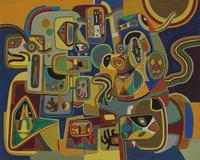
Young Man Talking to His Mother-in-Law
Steve Wheeler
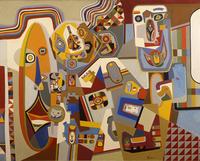
Laughing Boy Rolling
Steve Wheeler
Introducing Miss America II
Steve Wheeler
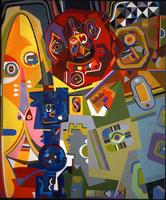
Laughing Boy
Steve Wheeler

Untitled W22 (Man Looking at Pork Chop)
Steve Wheeler
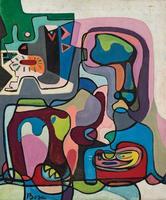
Wild Beast Roaming around the World
Peter Busa
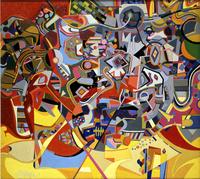
Woman Eating a Hot Dog
Steve Wheeler
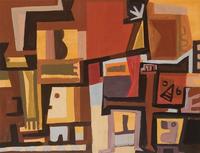
New Star
Peter Busa
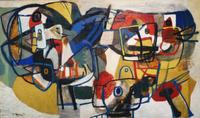
1951
Karel Appel
-
Karel Appel
Jack-in-the-Box
Steve Wheeler
Abstract 1
René Marcil
The key
Jackson Pollock
Strangers
Steve Wheeler
Untitled
Eileen Agar
Corne a Licou
Maurice Esteve
A repudiated woman can find no peace
George Ebrin Adingra