
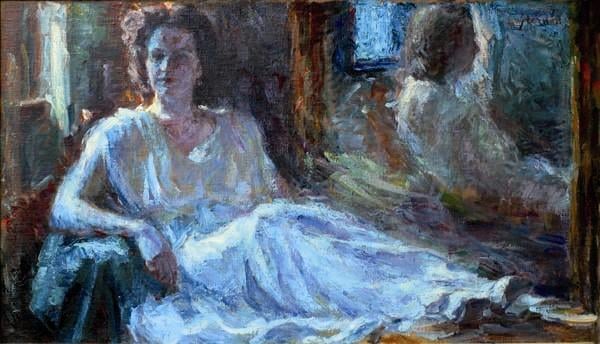
Lady in Blue
Expertenanalyse zu Matej Sternens Lady in Blue
Stil: Impressionism · Genre: portrait
"Lady in Blue" by Matej Sternen: An Expert Analysis
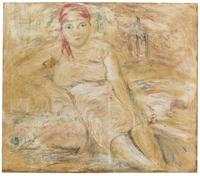
Matej Sternen’s Lady in Blue exemplifies the unique adaptation of Impressionist principles within Central European painting at the turn of the 20th century. As a Slovenian artist trained in Vienna and Munich, Sternen merged the French Impressionist fascination with light and color with a distinctly restrained, lyrical sensibility—a hallmark of the so-called “Slovene Impressionist” circle.
Significance within Impressionism and the Portrait Genre:
-
Expressive Color as Structure: True to the movement’s core, Sternen uses color—not line—to define form. The titular blue dominates the composition, ranging from cool ceruleans in the sitter’s dress to warmer, broken touches of azure and violet in the background. This chromatic unity creates an atmospheric envelope, dissolving hard contours and suggesting the figure through perceptual effects rather than meticulous detail. The blue becomes both subject and mood, evoking a sense of quiet introspection.
-
Light and the Fleeting Moment: Sternen captures the ephemeral quality of light upon fabric and skin. Short, visible brushstrokes—especially in the rendering of the dress and the soft halo of the background—convey the shimmer of outdoor or filtered daylight. The sitter’s face is modeled with subtle, overlapping dabs of pink, white, and pale blue, avoiding local color in favor of optical mixing. This approach aligns with the Impressionist goal of recording a transient instant—here, a paused, serene glance.
-
Cultural Adaptation: Unlike the bustling Parisian scenes of Monet or Renoir, Sternen’s portrait is quieter, more introspective. The “Lady” is anonymous, yet her calm demeanor and elegant poise reflect the bourgeoisie of the Austro-Hungarian Empire. Sternen’s brushwork is less aggressive than his French counterparts; he softens the edges, infusing the painting with a melancholic, almost Symbolist undertone. This synthesis of Impressionist technique with Central European decorum marks the work’s significance—it demonstrates how Impressionism was not merely imported but reimagined for a different cultural and emotional landscape.
Conclusion: Lady in Blue stands as a testament to Sternen’s mastery of Impressionist language while asserting a distinct regional identity. Its significance lies in its delicate balance: vibrant yet subdued, immediate yet timeless—a portrait that breathes without shouting, capturing both a person and a moment through the simple, powerful unity of blue.
Genre
Stil
Visuell ähnlich
20 Werke mit ähnlicher Komposition und Farbpalette
Untitled
Omer Mujadžić
Untitled
Omer Mujadžić
Portrait of An Unknown
Adalbert Erdeli
Woman
Stefan Luchian
Interior
Roderic O'Conor
Cecilia pregnant
Marià Fortuny
On the Couch
Matej Sternen
Nude in Blue Slip
Émilie Charmy
Sinfonia Azul (Maria)
Antonio Carneiro
Aristocrat Portrait (Lila, Artist's Niece)
Francisc Sirato
Two Women on a Sofa
Walter Sickert
Jeune Fille Au Travail
Vincenzo Irolli
Bela Czobel Girl
Bela Czobel
Neapolitan lady
Giuseppe De Nittis
Bela Czobel, Jeune Fille Lisant 1963
Bela Czobel
Act under Moonlight
Vera Nedkova
Woman Sitting
Francisc Sirato
Princess Mechtilde Lichnowsky
Oskar Kokoschka
Princess Aristizza Ghyka
George Demetrescu Mirea
Juanita sentada (descanso)
Armando Reveron