
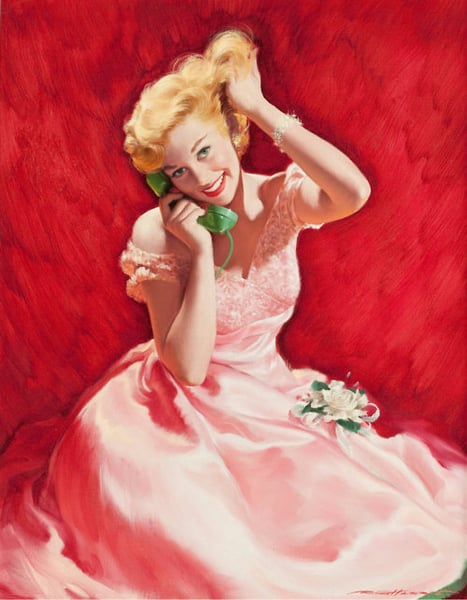
The Telephone Call
Expert analysis of Robert G. Harris’s The Telephone Call
Style: Poster Art Realism · Genre: portrait
Expert Analysis of "The Telephone Call" by Robert G. Harris
Style: Poster Art Realism | Genre: Portrait
Robert G. Harris's "The Telephone Call" exemplifies the distinctive qualities of Poster Art Realism—a style that merges the precision of academic realism with the bold, commercial clarity of mid-20th-century advertising. In this portrait, Harris captures not just a person but a moment of intimate, everyday drama: the act of placing or receiving a phone call.
Significance Within Its Style
Poster Art Realism flourished in the 1940s–1960s, particularly in American illustration, where it was used to sell everything from household goods to travel. Harris elevates this commercial idiom into a fine art statement. The composition is carefully staged for maximum narrative impact—a hallmark of the style. The framing is tight, focusing on the subject’s face and hands, with the telephone as the sole prop. Light falls in a controlled, almost studio-like manner, emphasizing the texture of skin and clothing while creating a soft halo around the figure. The palette is rich but restrained, with warm skin tones offset by cool shadows, giving the scene a nostalgic, slightly cinematic glow.
Genre as a Window to the Era
As a portrait, the work goes beyond mere likeness. The subject’s expression—attentive, perhaps a bit anxious or amused—invites viewers to imagine the conversation. This psychological engagement is a key feature of Harris’s best work. The telephone itself is a historical marker: its heavy black receiver and rotary dial place the scene firmly in the mid-20th century. Yet the emotional resonance—waiting, connecting, listening—remains timeless.
Why It Matters
"The Telephone Call" stands out because it encapsulates the ethos of Poster Art Realism: making the ordinary iconic. Harris uses the clarity of commercial art to celebrate everyday human experience. The painting is significant for how it bridges fine art illustration and popular culture, preserving a moment of analog communication in a world that was on the cusp of change. It is both a period piece and a universal meditation on connection, rendered with the crisp, accessible beauty that defines the best of American poster realism.
Visually similar
20 works with related composition and palette

Miss Sylvania
Haddon Sundblom
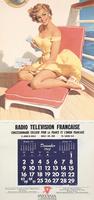
Sylvania Electric, Calendar Pin-Up, December 1962
Haddon Sundblom

Untitled Pin-up
Haddon Sundblom
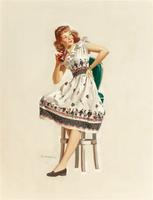
Sipping her Coca-Cola, Advertisement
Haddon Sundblom
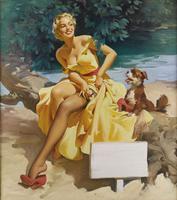
Shaw-Barton Calendar Company pinup
Haddon Sundblom
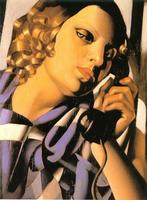
The Telephone
Tamara de Lempicka
Single Items
Raphael Kirchner
Eva Heramb
Gerda Wegener

Give Me a Ring
Haddon Sundblom
Diary
Norman Rockwell

The Arrangement
Jack Vettriano
Ellegant
Francis Picabia
Coca Cola Springboard Girl Tin Serving Tray
Haddon Sundblom

Dark Haired Girl In Black Skirt And Turquoise Blouse On A Floral Sofa
Gerda Wegener
Great American Nude
Tom Wesselmann
Intrusion
Alberto Vargas

The Lady Changed Her Style, Saturday Evening Post story illustration
Robert G. Harris
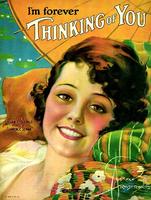
I'm Forever Thinking of You
Rolf Amstrong

Jeanne (Victory for a Soldier)
Alberto Vargas
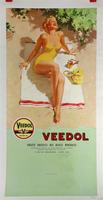
Veedol Pin-Up Advertisement
Haddon Sundblom