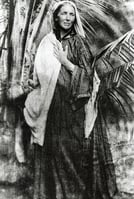
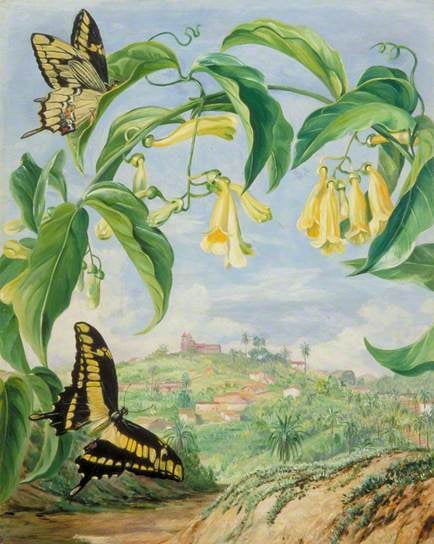
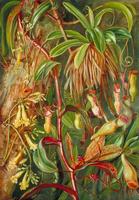
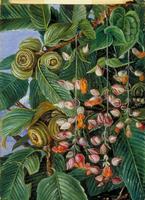
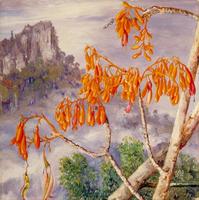
This artwork is a striking example of Marianne North’s unique synthesis of scientific observation and landscape painting, a hallmark of High Victorian Naturalism. While many flower painters of the era isolated their subjects against neutral backgrounds, North embeds the titular Yellow Bignonia and Swallow-Tail Butterflies within a wider environmental context—a distant view of Congonhas, Brazil. This compositional choice does more than provide scenery; it establishes the ecological setting, showing the plant and insect not as specimens in a vacuum, but as living components of a specific biome. The work’s significance lies in how it bridges the separate traditions of botanical illustration and topographical landscape. North’s precise rendering of the bignonia’s trumpet-shaped blooms and the butterflies’ wing patterns satisfies the Naturalist demand for empirical accuracy, while the atmospheric Brazilian hillside imbues the image with a sense of place and journey. This approach reflects North’s revolutionary methodology: a solo woman traveling the globe to paint in situ, capturing flora within its native habitat rather than in a controlled studio. The painting thus stands as a document of 19th-century global exploration, turning a botanical study into a vivid travelogue and asserting the artistic value of the natural world exactly as it appears.