Wilhelm Leibl sanatçısının Sleeping Savoyard Boy eseri hakkında uzman analizi
Tarz: Impressionism, Realism · Tür: genre painting
Expert Analysis: Sleeping Savoyard Boy by Wilhelm Leibl (c. 1872–73)
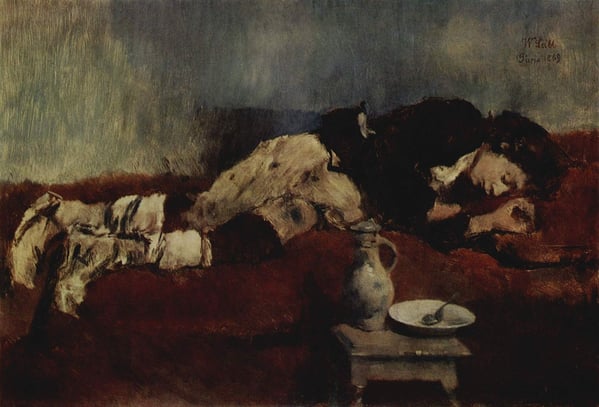
Wilhelm Leibl’s Sleeping Savoyard Boy stands at a fascinating crossroads between the gritty observation of Realism and the looser, more atmospheric concerns of Impressionism. While Leibl is primarily celebrated as a leading German Realist, this work reveals his willingness to absorb the visual innovations of his French contemporaries—specifically, the emphasis on natural light and momentary effect—without abandoning the psychological depth and solid draftsmanship of the Realist tradition.
The painting depicts a young itinerant boy, a Savoyard (a seasonal worker from the Alpine region), slumped asleep against a rough-hewn wall. Leibl treats this humble subject with the same gravity typically reserved for portraits of the bourgeoisie. The boy’s slumped posture and closed eyes evoke both vulnerability and a quiet, almost heroic resilience. The controlled palette of earthy browns, soft grays, and muted whites anchors the scene in the material reality of poverty and fatigue, while the diffuse, dappled light—suggesting the warmth of a midday nap—lends an impressionistic softness to the boy’s skin and clothing.
Significantly, Leibl’s handling of light and shadow here marks a departure from the hard-edged clarity of his earlier work. Instead of meticulous, topographical detail, he uses a looser, more broken brushstroke for the boy’s ragged coat and the stone wall, hinting at the fleeting quality of the moment. Yet he never fully dissolves the figure into pure optical sensation: the boy’s face, though softly modeled, retains a sculptural solidity that anchors the composition.
This painting is significant because it embodies the central tension of Leibl’s career—the desire to capture the authentic, unadorned life of ordinary people (a core Realist goal) while embracing the new, transient visual language of Impressionism. In Sleeping Savoyard Boy, Leibl proves that a “genre” scene of a sleeping child can bear the weight of both social observation and painterly innovation. The work stands as a quiet testament to the dignity of labor and rest, bridging the gap between the intensely descriptive Realism of artists like Gustave Courbet and the atmospheric, light-driven modernity of the Impressionists.
Görsel olarak benzer
İlişkili kompozisyon ve renk paletine sahip 20 eser
Berény Róbert, Zsuzsa,
Berény Róbert
Berény Róbert, Zsuzsa
Berény Róbert
Woman Sitting
Francisc Sirato
The Suicide
Edouard Manet
After the Ball
Edouard Vuillard
Berény Róbert, Pihenő Lány,
Berény Róbert
Scheiber Hugó, Festő Lány Masnival 1910
Scheiber Hugó
Woman reclining on a red divan
Chaim Soutine
The Sick Child
Edvard Munch
Villon - The Singer Fate Fashioned to Her Liking
Howard Pyle
Simone De...
Goran Djurovic
The Camden Town Murder, or What Shall We Do For the Rent?
Walter Sickert
Sleeping woman
Isaac Israels
Reclining Nude
Henri de Toulouse-Lautrec
Berény Róbert, Enterior Olvasó Nővel,
Berény Róbert
The Camden Town Murder
Walter Sickert
Portrait of Nikolay Pozniakov
Valentin Serov
The Day After
Edvard Munch
Äiti Ja Lapsi
Elin Danielson-Gambogi
Portrait of Yevdokia Loseva
Valentin Serov