Expertenanalyse zu Ernest Meissoniers Self-portrait
Stil: Realism · Genre: self-portrait
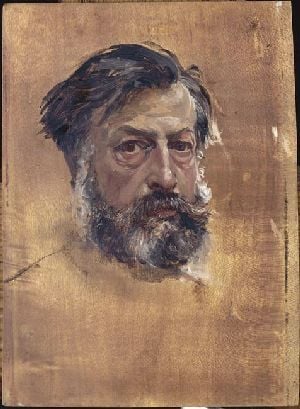
This self-portrait by Ernest Meissonier (1815–1891) is a revealing document of the artist’s identity and a masterclass in the precision-obsessed strain of Realism. While Meissonier is best known for his meticulously detailed historical and military scenes—often painted on a tiny scale with almost microscopic accuracy—his self-portrait shifts that same rigorous attention from grand narratives to the intimate examination of self.
Significance within Realism and Meissonier’s Oeuvre
-
Realism as Psychological Precision
Unlike the social realism of Courbet or the plein-air naturalism of the Barbizon school, Meissonier’s Realism was rooted in photographic exactitude and controlled studio craft. In this self-portrait, every brushstroke serves to document the artist’s physiognomy with near-scientific objectivity: the texture of skin, the glint of the eye, the precise fall of light on his dark coat. But beyond physical likeness, the work attains a psychological intensity—a calm, unwavering gaze that projects the persona of a serious, disciplined craftsman, not a romantic bohemian. -
Reflection on Artistic Identity
Meissonier was one of the most commercially successful and critically revered artists of his era (a status that later faded with the rise of Impressionism). His self-portrait functions as a statement of professional legitimacy. By portraying himself in ordinary, bourgeois dress with no theatrical props or painterly flourishes, he aligns his image with the values of accuracy, hard work, and middle-class respectability that his art championed. This contrasts sharply with the more dramatic or tortured self-presentations of contemporaries like Delacroix or Van Gogh. -
Technical Virtuosity
The painting demonstrates Meissonier’s hallmark finely brushed, enamel-like finish. Even in a simple bust-length format, he achieves a remarkable depth of tone and solidity of form. The subdued palette—blacks, browns, and warm flesh tones—is enlivened by subtle chromatic variations that reveal his obsession with how light models volume. In this sense, the self-portrait is both an advertisement for his technical skill and a quiet refutation of the loose, “sketchy” style that would soon dominate. -
A Bridge Between Academic and Realist Ideals
Meissonier occupied a unique position: he was a Realist in his devotion to observed detail, yet he remained a pillar of the Academic establishment (he exhibited at the Salon and was awarded the Légion d’Honneur). This self-portrait embodies that tension—it is Realist in its unidealized truth, yet academic in its polished execution. It captures a moment when Realism had not yet broken entirely from the official art world, but was instead redefining what “truth” could look like within the studio tradition.
In sum, this self-portrait is significant because it compresses Meissonier’s entire aesthetic philosophy into a single, contained image: the belief that the highest art arises from patient, objective observation, and that even a portrait of oneself can be a quiet monument to craft. It stands as a key artifact of the French Realist movement’s more disciplined, bourgeois wing—a counterpoint to the more radical, socially engaged Realism that we often remember today.
Visuell ähnlich
20 Werke mit ähnlicher Komposition und Farbpalette
Auto-Retrato
Antonio Carneiro
Portrait of an old man
Aleksandr Deyneka
Self-portrait
Jean-Baptiste Carpeaux
Robert Braithwaite Martineau
William Holman Hunt
Self-portrait
Paul-Albert Besnard
Self Portrait
Claude Monet
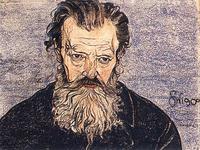
Portret Ojca
Stanisław Wyspiański
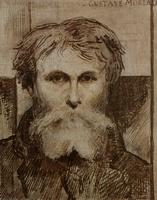
Self-portrait
Gustave Moreau
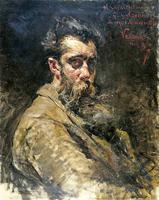
Portrait of the painter Giuseppe Garzolini
Umberto Veruda
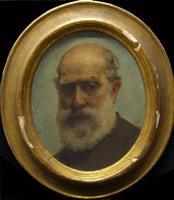
Self-portrait
Francesco Hayez
Kéztanulmány
Bela Czobel
L’Antiquaire Georges Joseph Demotte
Henri Matisse
Self-Portrait in a Striped T-Shirt
Henri Matisse
Federico Rubio y Gali
Alejandro Cabeza
Learning through copying old masters. Rembrandt
Alfred Freddy Krupa
Portrait
Thomas Eakins
Portrait V.A. Kastalsky
Boris Kustodiev
Portrait of Georges de Bellio (1828-94)
Giovanni Boldini
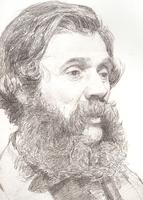
Portrait of William Moore
Albert Joseph Moore
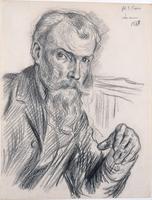
Portrait of Henri-Edmond Cross
Maximilien Luce