Analisi esperta di Attacking the Grizzly Bear di George Catlin
Stile: Realism
Expert Analysis of "Attacking the Grizzly Bear" by George Catlin
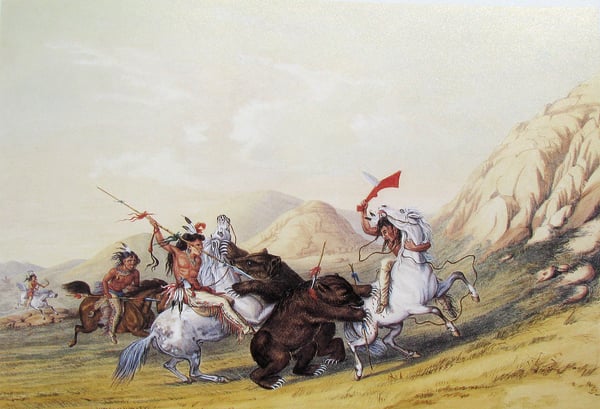
Within the framework of 19th-century Realism, George Catlin’s "Attacking the Grizzly Bear" stands as a significant testament to the artist’s dual mission: to document a vanishing American frontier and to elevate the ordinary—and often perilous—encounters of frontier life into a matter of historical record.
Significance within Realism
Catlin’s work exemplifies Realism’s rejection of idealized, allegorical, or mythological subjects in favor of direct, unembellished observation of contemporary life. Here, the grizzly bear attack is not a romanticized hunt but a raw, life-or-death struggle. Every detail—the muscled tension of the bear, the precarious stance of the hunters on horseback, the dust and chaos of the prairie—is rendered with forensic accuracy. This aligns with Realism’s core principle: truth through faithful representation of the specific, the local, and the ruggedly everyday.
Cultural and Historical Importance
Catlin’s series of Plains Indian and frontier scenes was unprecedented in its commitment to ethnographic and natural-history documentation. "Attacking the Grizzly Bear" captures a real, recurring danger for both Native tribes and white explorers. By freezing this moment of violent confrontation, Catlin does more than depict action; he preserves the visceral texture of a rapidly changing landscape. The grizzly bear—a symbol of untamed wilderness—is shown not as a monster but as a powerful creature whose threat is both real and dignified, a counterpart to the bravery of the hunters.
Artistic Technique
Catlin’s chunky, direct brushwork and earthy palette—ochres, grays, muted greens—avoid any glossiness. The composition thrusts the viewer into the midst of the fray: the bear rears on its hind legs, claws extended, while the rider’s horse panics. The diagonal lines of the horses’ bodies and the bear’s arching spine create a stark dynamism, a hallmark of Catlin’s observational style. There is no heroism, only survival.
Why It Matters
In the context of Realism, Catlin’s "Attacking the Grizzly Bear" is significant because it refuses to sentimentalize the frontier. It stands as a raw, factual record—a visual dispatch from a world where man and animal met as equals, and where the artist’s duty was to witness without flinching.
Museum / Gallery
Stile
Tag
Visivamente simili
20 opere con composizione e palette affini
Indian Fight, #1
Charles M. Russell
Horse Racing of Sioux Indians near Fort Pierre, plate 30 from Volume 1 of 'Travels in the Interior of North America'
Karl Bodmer
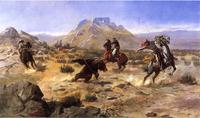
Capturing the Grizzly
Charles M. Russell
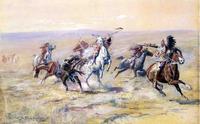
When Sioux and Blackfoot Meet
Charles M. Russell
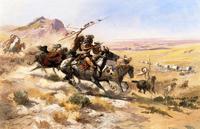
Attack on a Wagon Train
Charles M. Russell
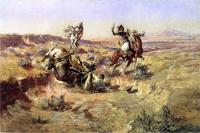
The Broken Rope
Charles M. Russell
The Making of a Warrior
Charles M. Russell
The Silenced War Whoop
Charles Schreyvogel
Cree War Party
Charles M. Russell
Roping a Grizzly
Charles M. Russell
When Blackfeet and Sioux Meet
Charles M. Russell
Sun River War Party
Charles M. Russell
The Warriors
Maynard Dixon
Indians Discovering Lewis and Clark
Charles M. Russell
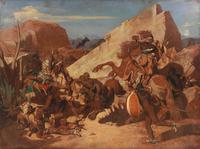
Lion hunting among the Indians
Jean-Leon Gerome
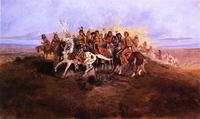
The War Party
Charles M. Russell
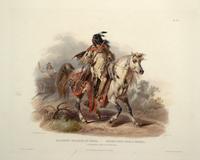
A Blackfoot Indian on Horseback, plate 19 from Volume 1 of 'Travels in the Interior of North America'
Karl Bodmer
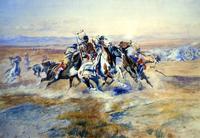
The Attack
Charles M. Russell
The Coming of the White Man
Charles M. Russell
Stage Coach Attack
Charles M. Russell