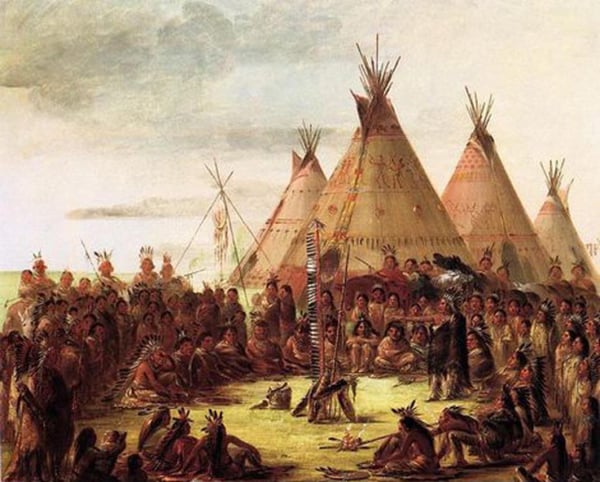
Sioux War Council
Análisis experto de Sioux War Council de George Catlin
Estilo: Realism · Género: genre painting
Expert Analysis of "Sioux War Council" by George Catlin
George Catlin’s "Sioux War Council" (circa 1832–1833) is a landmark work within the Realist tradition and a vital document of 19th-century Native American life. As a genre painting, it captures a specific cultural moment—the deliberation and decision-making process of a Sioux war party—with an ethnographic accuracy that distinguishes Catlin’s entire oeuvre.
Significance within Realism:
Catlin was a pioneering American Realist, but his realism served a dual purpose: aesthetic truth and historical preservation. Unlike many contemporaries who romanticized Indigenous subjects, Catlin aimed for meticulous fidelity. In this work, the details—the draped buffalo robes, the feathered war bonnets, the painted tribal symbols on the warriors’ faces and shields, the arrangement of the council circle—are rendered with careful observation. The muted earth tones and natural lighting avoid theatricality, grounding the scene in the actual plains environment. This commitment to verifiable detail aligns with the core Realist goal of depicting ordinary people and authentic activities without idealization.
Significance as a Genre Painting:
Genre painting typically elevates scenes of daily life, and here Catlin elevates a moment of political and military gravity. The composition focuses on the shared process: warriors seated on the ground in a loose circle, leaning forward, gesturing, and listening. By foregrounding the universal human act of council, Catlin humanizes his subjects for a white American audience often exposed only to stereotypes. The work is not a battle scene but a scene of deliberation—intellectual and strategic—underscoring the complexity of Sioux governance.
Historical and Documentary Importance:
Catlin’s self-appointed mission was to record “the looks and customs of the vanishing races of native man in America.” "Sioux War Council" is part of his Indian Gallery, which he later toured to educate the public. The painting is significant because it captures specific regalia and ritual objects (pipes, coup sticks, calumets) that might otherwise be lost. Moreover, it shows intertribal or war-party dynamics that few white artists witnessed. Catlin’s realism here is also a form of advocacy: by presenting the council as a scene of reasoned authority, he counters contemporary narratives of Indigenous savagery.
Artistic Execution:
While Catlin’s style lacks the refined brushwork of European academic Realism, his direct, almost journalistic approach gives the work a raw immediacy. The figures are solidly modeled, their poses naturalistic, and the composition balanced around the central speaker. The painting’s power lies in its apparent transparency—we feel we are observing a real event. This verisimilitude is what makes the work a touchstone for both art history and anthropology.
In sum, "Sioux War Council" is significant because it fuses Realism’s commitment to truth-telling with genre painting’s celebration of lived experience, creating an invaluable visual record of Sioux political culture and a quiet rebuttal to prejudice. Catlin’s work remains a cornerstone of American Realist art and a poignant monument to the peoples he admired.
Género
Estilo
Visualmente similares
20 obras con composición y paleta relacionadas
The Silk Robe
Charles M. Russell
Cowboy Bargaining for an Indian Girl
Charles M. Russell
Lewis and Clark Meeting the Mandan Indians
Charles M. Russell
Funeral Scaffold of a Sioux Chief near Fort Pierre, plate 11 from Volume 2 of 'Travels in the Interior of North America'
Karl Bodmer
A Piegan Flirtation
Charles M. Russell
Western Montage
Charles M. Russell

Indian Squaw
Charles M. Russell
Water Girl
Charles M. Russell
Single Handed
Charles M. Russell
Sioux teepee from Volume 1 of 'Travels in the Interior of North America'
Karl Bodmer
Sun Worship in Montana
Charles M. Russell
Sioux Torturing a Blackfoot Brave
Charles M. Russell
Indian Hunters' Return
Charles M. Russell
Big Snake, Chief of the Blackfoot Indians, Recounting his War Exploits to Five Subordinate Chiefs
Paul Kane
The Mandan Dance
Charles M. Russell
Indian Beauty Parlor
Charles M. Russell
War Council
Charles M. Russell
Missouri Indians
Karl Bodmer
Teepees at Sunset
Maynard Dixon
A Skin Lodge of an Assiniboin Chief, plate 16 from Volume 1 of 'Travels in the Interior of North America'
Karl Bodmer