
Expert analysis of Claudio Bravo’s Red Hats
Style: Hyper-Realism · Genre: still life
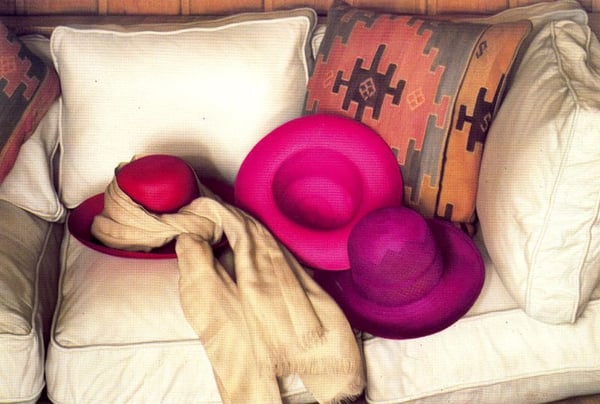
Expert Analysis of "Red Hats" by Claudio Bravo
Claudio Bravo’s Red Hats stands as a masterful example of Hyper-Realism, a movement that emerged in the late 1960s and 1970s as a radical extension of Photorealism, distinguished by its obsessive attention to detail and an almost uncanny illusion of life. While Hyper-Realism often replicates photographic sources, Bravo—like contemporaries such as Audrey Flack or Ralph Goings—infuses his still lifes with a heightened sense of tactile presence and psychological stillness that elevates them beyond mere mimicry.
Significance within Hyper-Realism:
Bravo’s work is significant for its ability to render ordinary objects—here, a pile of red hats—with such precision that the viewer is forced to question the boundary between painting and reality. The hats’ deep crimson wool, the precise weave of each thread, the subtle shadows that suggest weight and volume, and the soft folds that mimic draped fabric all demonstrate Bravo’s technical virtuosity. Unlike many Photorealists who relied on airbrush and projected imagery, Bravo painted entirely by hand, achieving a brushwork so invisible that the surface becomes a seamless window onto a world of heightened verisimilitude.
Distinctive Characteristics in Red Hats:
-
Materiality and Texture: Bravo was renowned for capturing luxury fabrics and objects—silks, velvets, paper, glass. In Red Hats, the red dye appears almost palpable; the hats are not just red but a spectrum of scarlets, carmines, and crimsons modulated by light and shadow. This attention to materiality connects to Baroque vanitas traditions, yet Bravo’s still lifes lack moralizing symbols. Instead, they celebrate the simple, sensuous beauty of manufactured things.
-
Composition and Light: The hats are arranged in a seemingly casual pile, yet each angle and overlap is meticulously calculated to create a dynamic interplay of convex and concave forms. The lighting is theatrical, often a single strong directional source (reminiscent of Caravaggio), which throws sharp highlights and deep, velvety shadows. This chiaroscuro effect gives the hats an almost sculptural mass, making them appear ready to slip off the canvas.
-
Illusion and Reality: Bravo’s hyper-realism is not cold or sterile; it carries a subtle surreal charge—a sense that these ordinary objects are somehow charged with a mysterious, attention-demanding presence. The hats are removed from any human context (no wearer, no room), floating in a neutral, undefined space. This isolation forces the viewer into a silent contemplation of form, color, and craft, turning a simple still life into a meditation on perception itself.
Placement in Bravo’s Oeuvre:
Chilean-born Bravo (1936–2011) relocated to Tangier, Morocco, where he developed his signature style—an East-meets-West fusion of Old Master precision (his debt to Zurbarán and the Spanish bodegón tradition is evident) and contemporary Postmodern clarity. Red Hats exemplifies his late-career focus on intricate drapery and bundled textiles, works that both challenge the painter’s skill and reward the viewer’s slow looking.
Conclusion:
Red Hats is significant because it demonstrates the highest achievement of Hyper-Realism: not the slavish copy of a photograph, but a painstakingly constructed vision that makes the mundane extraordinary. Bravo transforms a cluster of ordinary headwear into a symphony of color, texture, and light—an emblem of the painter’s almost magical ability to bring something into being that was not there before. In doing so, he affirms the enduring power of still life as a genre that tests the limits of representation and the patience of the eye.
Genre
Style
Visually similar
20 works with related composition and palette
Chapeau blanc
Marcel Broodthaers
Untitled
Kansuke Yamamoto
Fausto
Eduardo Arroyo
Schoolgirl at St Kilda Beach
Charles Blackman
Ernest
Cassandre
Summer
Jose Higuera
Timpul Lui Goya
Gil Nicolescu
The Fire's Man
Alexander Rodchenko
The Expectation
Richard Oelze
Under the Hat
Francesco Clemente
The album "Circus"
Fernand Leger
Scheiber Hugó, Szalmakalapos Férfi
Scheiber Hugó

For Sylvia Plath
Elina Brotherus
Scheiber Hugó, Hölgy Vörös Rúzzsal 1930
Scheiber Hugó
Schoolgirl
Charles Blackman
Back Nude
Bela Czobel
Ian Keteku
Francis A. Willey
Scheiber Hugó, Hölgy Kalapban
Scheiber Hugó
Děvčátko
Josef Capek
Vincent
Abu Faisal Sergio Tapia