
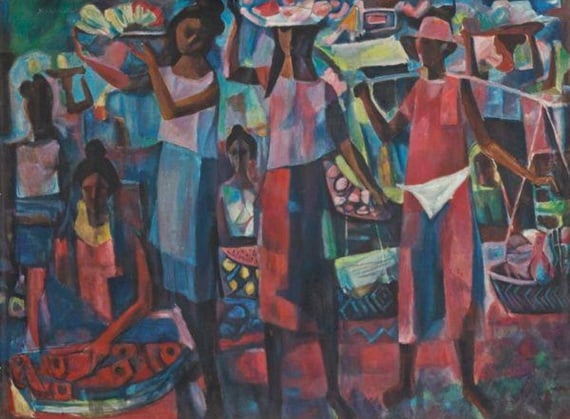
Analisi esperta di Market Vendors di Vicente Manansala
Stile: Cubism · Genere: genre painting
Expert Analysis of "Market Vendors" by Vicente Manansala
Vicente Manansala’s “Market Vendors” stands as a pivotal example of how Cubism was adapted to distinctly Filipino subject matter, merging a revolutionary European style with the rhythms of local daily life. In this genre painting, Manansala depicts a bustling market scene — a staple of Philippine communal existence — through the lens of transparent Cubism, his signature innovation. Unlike the opaque, faceted forms of early Cubism (Picasso, Braque), Manansala employs translucent planes and overlapping, semi-transparent shapes that allow light and color to bleed through, creating a sense of movement, warmth, and even the tangible humidity of a Southeast Asian market.
Significance within Style and Period
-
Hybridization of Cubism: Manansala’s work is significant for decoupling Cubism’s formal language from its purely European context. He retains the fractured planes and simultaneous viewpoints of analytic Cubism but softens them with luminous, diaphanous washes. The result is a Cubism that feels less intellectual and more visceral — grounded in the textures of woven baskets, piled produce, and woven hats.
-
Transparent Cubism as National Modernism: As a leading figure of the Philippine modern art movement, Manansala used this technique not merely as formalism but as a means to depict social reality. In “Market Vendors,” the transparent layers evoke the interwoven lives of vendors and buyers, the density of commerce, and the transient, fleeting glances exchanged in a crowded marketplace. The work thus bridges avant-garde aesthetics with a humanistic, even gentle, social commentary — making it significant as a modernist response to post-war Philippine identity.
-
Genre Painting Elevated by Structure: While genre paintings often aim for anecdotal charm, Manansala elevates the humble market scene through rigorous structural design. The overlapping geometric forms (triangular awnings, rectangular stalls, oval faces) create a rhythmic, almost musical composition. The fragmented figures are not abstracted to obscurity; instead, they retain a recognizable humanity, demonstrating that abstraction and narrative can coexist.
In essence, “Market Vendors” is significant because it localizes Cubism — proving that a Western modernist vocabulary could authentically express the spirit, color, and rhythm of Filipino life. Manansala’s transparent cubes do not dismantre reality, they intensify it, offering a view of community that is both modern and deeply rooted.
Genere
Stile
Visivamente simili
20 opere con composizione e palette affini

Two girls with Tjaping
Henk Ngantung
Peasant Woman with Buckets and a Child
Kazimir Malevich
Peasant from Oltenia with Yoke
Rudolf Schweitzer-Cumpana

Marché, Haïti
Beauford Delaney
A Lady at Market
Olusola David, Ayibiowu
Dans La Vie - book cover drawing
Theophile Steinlen

Composition With Figures
Mario Zanini

WOMEN AND CHILD, EASTWOOD, PRETORIA
Gerard Sekoto
Flower Sellers 1991
Kenneth Baker

Art Go
Wang Guangyi
Seller of lemonade
Martiros Sarian

Midday
Boyukagha Mirzazade

Fisherwomen
Lin Fengmian

The moment of truth II
Paul Gauguin

Girl of the Fields
Petros Malayan

South Indian Villagers Going to a Market
Amrita Sher-Gil
Crop Harvesting
Vasile Dobrian

African Figures
Walter Battiss

GOING HOME
Gerard Sekoto

The Market
Walter Battiss