Dorothea Tanning sanatçısının A Very Happy Picture eseri hakkında uzman analizi
Tarz: Surrealism · Tür: symbolic painting
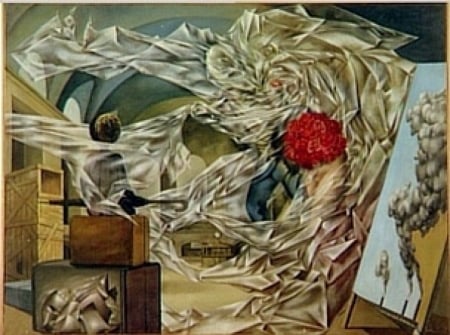
Dripping with the dark irony characteristic of Dorothea Tanning’s most compelling work, A Very Happy Picture (1947) presents a scene that is anything but the cheerful domestic snapshot its title suggests. The composition is dominated by a violent, spectral whirlwind of bed linens that seem to have taken on a life of their own, engulfing a central figure whose presence is only hinted at by a glimpse of legs and a shoe. This "tornado of domesticity" transforms the safety of the bedroom into a site of psychological turbulence. At the heart of this chaotic vortex sits a massive, blood-red floral bouquet—perhaps a rose or peony—which replaces the figure's head, symbolizing a surrender to overwhelming passion, loss of identity, or the suffocating nature of traditional feminine roles.
To the left, a rigid, doll-like figure stands atop a stack of packing crates and suitcases, holding a tennis racket with an air of detached alienation. This juxtaposition of the static, prepared traveler against the fluid, destructive energy of the central figure creates a palpable tension, suggesting themes of displacement and the anxiety of departure. The architectural setting, reminiscent of a stage set with its deep shadows and skewed perspective, amplifies the uncanny atmosphere. Meanwhile, an easel on the right displays a painting of smoke-belching chimneys, hinting at an intrusion of the industrial or the external world into this private, dreamlike space.
Painted shortly after Tanning moved to Sedona, Arizona, with her husband Max Ernst, this work exemplifies her unique contribution to Surrealism. While her male counterparts often objectified the female form, Tanning used the visual language of the subconscious to explore the internal female experience. The painting subverts the post-war ideal of the "happy housewife," revealing the latent anxieties and transformative terrors hidden within the home. The exquisite, precise rendering of the translucent drapery contrasts sharply with the disturbing narrative, forcing the viewer to confront the beautiful nightmare of a reality where the inanimate refuses to stay still.
Museum / Gallery
Görsel olarak benzer
İlişkili kompozisyon ve renk paletine sahip 20 eser
Musical Chairs
Dorothea Tanning
Study for the set of 'Romeo and Juliet'
Salvador Dali
Anti-Protonic Assumption
Salvador Dali
Revelation
Yasuo Kuniyoshi
Assumpta Corpuscularia Lapislazulina
Salvador Dali
Invasion of Eternity
Nicolae Maniu
Design for the Death Scene in 'Don Juan Tenorio'
Salvador Dali
Disasters of Mysticism
Roberto Matta
L'hommage à Callot
Francis Gruber
Illumined Pleasures
Salvador Dali
Palaestra
Dorothea Tanning
The Double Dream of Spring
Giorgio de Chirico
Portrait of Mrs. Harrison Williams
Salvador Dali
Gradiva
Andre Masson
Palladio's Corridor of Dramatic Surprise
Salvador Dali
The Dream
Esteban Frances
Leave all hope
Alekos Kontopoulos
En se dévorant
Theo Gerber
Untitled (Composition - Courtyard of the Escorial with Figure and Sebastian De Morra, Veldzquez's Dwarf)
Salvador Dali
Microphysical Madonna
Salvador Dali