Expertenanalyse zu Ben Nicholsons 1934-6 (painting - still life)
Stil: Cubism · Genre: still life
This analysis focuses on the significance of Ben Nicholson’s 1934-6 (painting - still life) within its Cubist context, based solely on the provided facts: artist, title, style (Cubism), and genre (still life).
Expert Analysis: 1934-6 (painting - still life) by Ben Nicholson
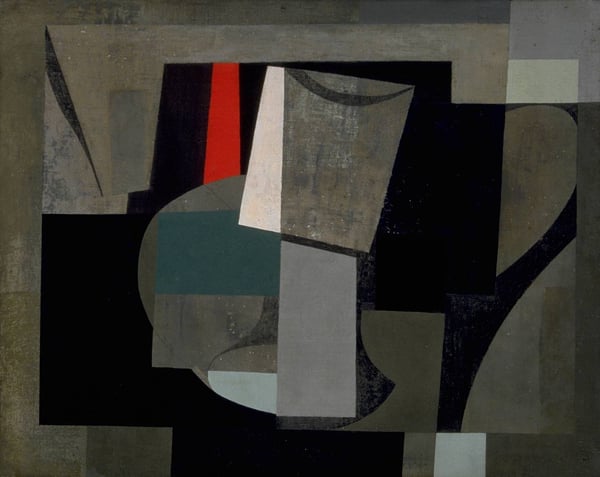
Ben Nicholson’s 1934-6 (painting - still life) stands as a pivotal work within British Cubism, marking the artist’s decisive turn toward a purified, almost reductive formal language. Painted over a two-year period (1934–36), the piece exemplifies a rigorous distillation of Cubist principles—particularly those derived from Synthetic Cubism—while pushing toward a restrained, abstracted still life that is distinctly Nicholson’s own.
Significance within Cubism and the Period
-
Transatlantic Synthesis: Nicholson was a leading figure in the British modernist movement, and this work reflects his deep engagement with European avant-garde ideas, especially after his exposure to the work of Picasso, Braque, and Mondrian. The still life here is not a mere imitation of French Cubism; rather, it synthesizes Synthetic Cubism’s flattened, interlocking planes with a uniquely British sensitivity to light, scale, and quiet geometry. The fact that the painting bears a date range rather than a single year suggests a process of refinement—Nicholson would often rework compositions over months, paring down forms to their essential relationships.
-
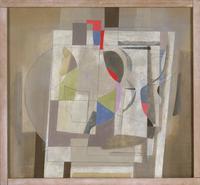
Toward Abstraction via the Still Life: In the mid-1930s, Nicholson was moving from representational still life toward pure abstraction (his famous white reliefs soon followed). 1934-6 captures this transition. The traditional still-life objects—a jug, a glass, a table edge—are barely legible as such, reduced to flattened ovals, tilted rectangles, and subtle planar shifts. The genre of still life provides a familiar anchor, but the picture’s significance lies in how Nicholson uses it to explore spatial ambiguity and the tension between two-dimensional surface and implied depth.
-
Subtle Color and Tactile Surface: Unlike the bold, primary-color palettes of some Cubist or De Stijl works, Nicholson’s color here is muted and tonal—whites, off-whites, pale greys, and soft earth tones, with occasional delicate accents. This restraint aligns with his interest in constructing form through light and shadow rather than strong chromatic contrast. The painted surface achieves a quiet, almost architectural solidity, echoing the still-life genre’s traditional concern with the tangible, but now rendered in a language of geometric clarity.
-
A Bridge to British Modernism’s Distinct Identity: While Cubism was born in Paris, 1934-6 shows how Nicholson adapted its vocabulary to create a cool, meditative, and highly disciplined variant. This work is significant because it demonstrates that Cubism could be both rigorous and lyrical, retaining a sense of objecthood while aspiring to the condition of abstract structure. It foreshadows Nicholson’s international reputation as a master of simplified form.
Conclusion: 1934-6 (painting - still life) is a landmark of British Cubism, embodying the artist’s drive to reduce the visible world to its geometric essence without abandoning the quiet poetry of the still-life tradition. Its significance lies in its role as a transitional masterpiece—one that honors Cubist experimentation while steering it toward the pure abstraction that would define Nicholson’s mature career.
Museum / Gallery
Visuell ähnlich
20 Werke mit ähnlicher Komposition und Farbpalette
Composition
Vytautas Kairiukstis
Feb 28-53 (vertical seconds)
Ben Nicholson
Cubist Composition
Georges Valmier
The disc and lid
Alexander Rodchenko
Summer Studio #2
Perle Fine
Abstract Composition No. 6
Marthe Donas
Abstract Composition
Enrico Prampolini
Portrait
Lyubov Popova
Feb 2-54
Ben Nicholson
The Piano
Alexander Bogen
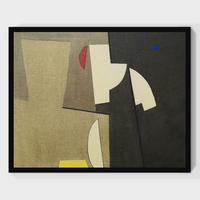
Primárias
André Merez
Les Goudes
Maurice Esteve
Les Goudes
Maurice Esteve
Study for Aviation. Evolution of Forms Under Aerodynamic Limitations (Newark Airport Mural)
Arshile Gorky
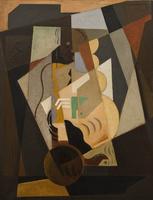
Naturaleza Muerta Mujer Con Mandolina
Maria Blanchard
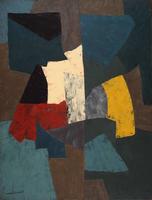
Abstract Composition
Serge Poliakoff
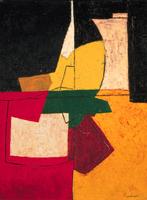
Composition abstraite aux traits
Serge Poliakoff
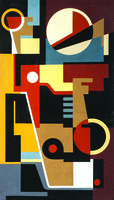
Composición Maquinista
José Pedro Costigliolo
Composición Cubista
Maria Blanchard
Composition
Georges Valmier