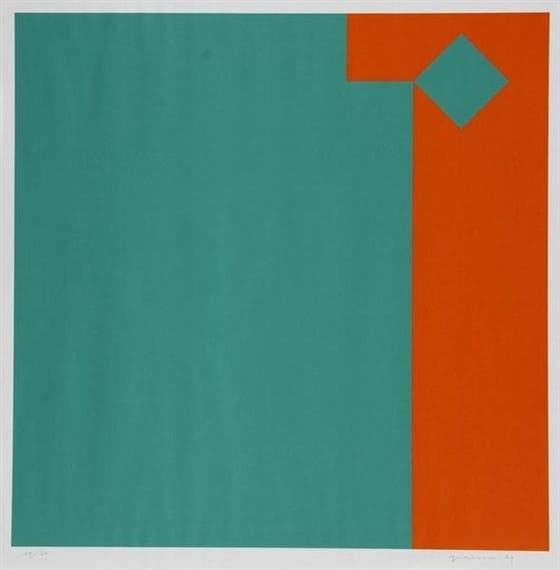
Expert analysis of Camille Graeser’s Grün / Orange 3:1
Style: Concretism · Genre: abstract
Expert Analysis of Camille Graeser's Grün / Orange 3:1 (Concretism, abstract)
Camille Graeser’s Grün / Orange 3:1 is a quintessential example of Swiss Concrete art, a movement that sought to strip painting of all illusionistic or symbolic content, reducing it to pure geometric form, color, and mathematical structure. The title itself reveals the work’s central organizing principle: a precise 3:1 ratio governing the relationship between the green and orange elements—most likely adjacent color planes or a dominant field versus a subordinate one. This ratio is not decorative but structural, embodying Concrete art’s belief that a painting’s composition should be self-evident and derived from objective, rational decisions.
Graeser, a member of the Zurich-based group Allianz alongside Max Bill and Richard Paul Lohse, championed a rigorous, non-representational abstraction where color and shape operate as autonomous forces. In Grün / Orange 3:1, the choice of complementary hues (green and orange) creates a dynamic visual tension—a calculated push-and-pull that activates the picture plane without resorting to spatial depth. The flat, unmodulated application of color underscores the work’s materiality, while the geometric demarcation (likely rectangles or irregular polygons) emphasizes the page-like, planar surface.
What makes this work significant is its exemplary demonstration of Concrete principles: the artwork is neither an interpretation of nature nor an expression of emotion but a self-contained, constructed reality. The 3:1 proportion invites the viewer to experience color and form as measurable quantities, turning perception into an act of comparative analysis. Graeser’s piece thus stands as a landmark of mid-20th-century geometric abstraction, where the logic of mathematics and the immediacy of color merge into a singular, irreducible visual statement.
Visually similar
20 works with related composition and palette
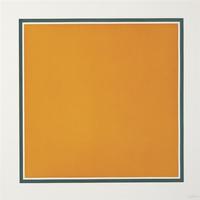
A Square With Colors Superimposed Within a Border
Sol LeWitt
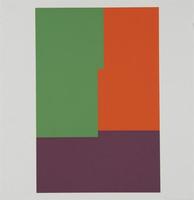
Untitled
Verena Loewensberg
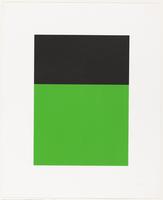
Black-Green from the Series of Ten Lithographs
Ellsworth Kelly
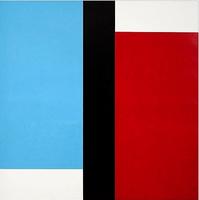
Adam and Eve (#2)
Frederick Hammersley
Untitled
Verena Loewensberg
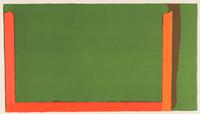
Untitled (Litograph)
John Hoyland
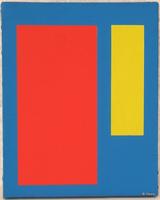
Radical III
Aurelie Nemours
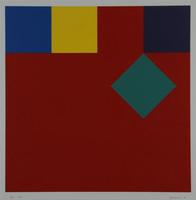
Disloziertes grünes Quadrat
Camille Graeser
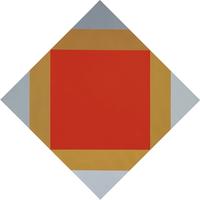
Red Nuclear
Max Bill
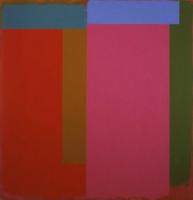
Marker California
Doug Ohlson
Untitled
Marc Vaux
Other Colors
James Bishop
Untitled
Robert Barry
Progetto B/V
Rodolfo Arico
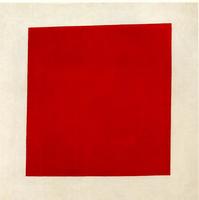
Red square
Kazimir Malevich
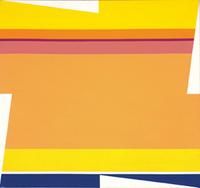
Rotation B
Larry Zox
Jasmine
Anne Appleby
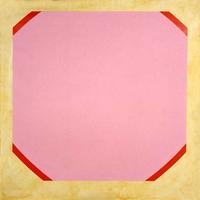
Cherokee Blanket
Walter Darby Bannard
"Cool" Series No. 7 (Square Shooter)
Perle Fine
Infinity field, Nemea Series #5
Theodoros Stamos