
Analisi esperta di Interior di Valerio Adami
Stile: Pop Art · Genere: interior
Expert Art Historical Analysis: "Interior" by Valerio Adami
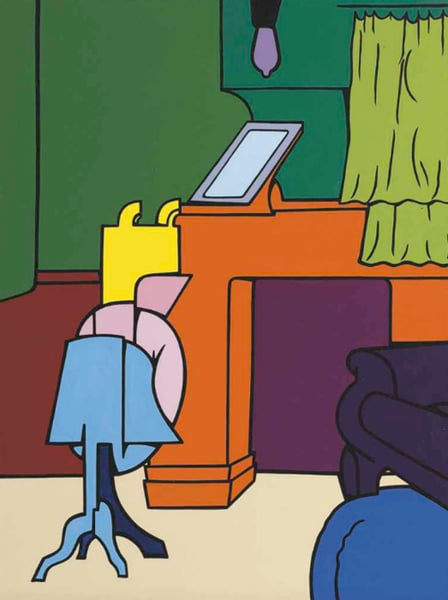
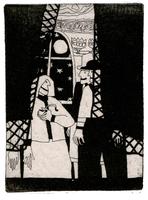
Valerio Adami’s Interior is a striking example of European Pop Art, a movement that distinguished itself from its American counterpart by merging mass-media imagery with philosophical and art-historical allusions. While American Pop artists like Warhol and Lichtenstein focused on consumer icons and comic-strip sources, Adami’s work—especially in the genre of interior—elevates the everyday domestic space into a stage for visual and intellectual play.
Significance within Style and Period
-
Pop Art’s European Refinement: Adami’s Interior exemplifies how Pop Art in Europe often retained a closer link to modernist painting traditions, particularly the hard-edged abstraction and bold poster-like graphics. The work uses the flattened, stylized figures and saturated colors typical of Pop, but introduces a more deliberate, almost architectural geometry. This places Adami within a generation that used pop vocabulary to critique, rather than celebrate, the spectacle of modern life.
-
The Interior as a Conceptual Space: Unlike traditional interior scenes (e.g., by Vuillard or Matisse) that emphasize atmosphere or intimacy, Adami’s Interior fragments the room into sharp black outlines and flat, unmodulated zones of color—a technique that recalls both comic strips and the clarity of sign painting. The result is a disorienting yet playful flattening of depth, turning the home into a puzzle of competing perspectives. This treatment highlights how Pop Art could transform the most private, banal environment into a graphic, almost theatrical performance.
-
Hard-Edged Line and Chromatic Boldness: Adami’s signature black contour lines (often compared to the work of Roy Lichtenstein) serve not to model form but to isolate and emphasize each element. In Interior, doors, furniture, and figures are delineated with a mechanical precision that denies the hand of the artist—a Pop tactic that questions authorship and originality. The use of primary colors (reds, blues, yellows) alongside contrasting whites and blacks gives the work a crisp, poster-like energy, positioning it firmly within the mid-20th-century visual language of advertising and graphic design.
-
Narrative and Subtext: Many of Adami’s interiors contain subtle references to literature, mythology, or political iconography—a trait that makes his brand of Pop more cerebral than its American roots. Interior likely embeds such allusions within its domestic setting, inviting viewers to decode the scene as a kind of modern allegory. This intellectual layering is significant because it demonstrates that Pop Art could be simultaneously accessible (through its comic-like style) and dense (through its iconographic hints), challenging the era’s assumption that popular imagery is inherently shallow.
Conclusion: Interior by Valerio Adami is significant for its ability to fuse the graphic, mass-cultural appeal of Pop Art with a European sense of formal rigor and conceptual depth. It reimagines the interior—a classic genre—through a Pop lens, making the familiar strange and the ordinary remarkable. In doing so, Adami broadens the scope of Pop Art, proving that the movement was not merely a reflection of consumer society but a sophisticated tool for rethinking how we see space, objects, and the stories they contain.
Visivamente simili
20 opere con composizione e palette affini
Interno con piano forte
Valerio Adami
Night Talk. From the Album 'Actors'
Viktor Pivovarov
La Mort
Jean Hugo
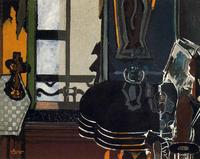
The Salon
Georges Braque
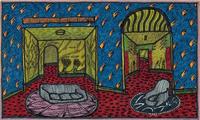
Untitled
David Lynch
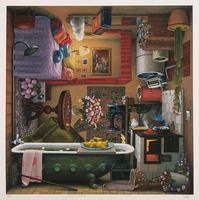
Boudoir
Jacek Yerka
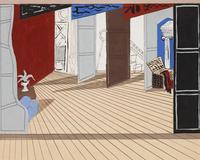
Design for the Cochrane review
Christopher Wood
Suburban Interior
Howard Arkley
Braque Curtain
Patrick Caulfield
Greengrocer Apollo
Nikos Hadjikyriakos-Ghikas
Dreams No. 2
Jacob Lawrence
Victorian Parlor Still Life
Horace Pippin
The Man of the Woods and the Cat of the Mountains
R. B. Kitaj
The Painter
Sandor Bortnyik
Riviera Window, Cros De Cagnes
Paul Nash
Open Window
Raoul Dufy
Gioconda
Rene Magritte
Monochrome red (theater)
Yves Klein
Woman Reading to a Little Girl
Felix Vallotton
Untitled
EtchingRoom1