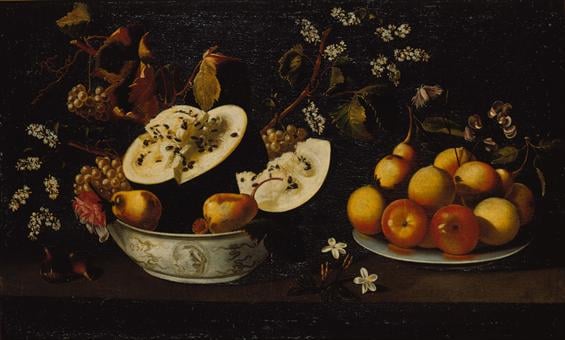
Expert analysis of Josefa de Obidos’s Natureza morta com frutos e flores
Style: Baroque · Genre: still life
Expert Analysis: "Natureza morta com frutos e flores" by Josefa de Obidos
Josefa de Obidos (1630–1684) stands as one of the most remarkable female painters of the Iberian Baroque, and this still life exemplifies the understated yet masterful naturalism that defines her contribution to the genre. Painted during a period when women artists were rarely permitted to work from live models or study anatomy, Obidos specialized in still life and religious subjects—genres considered appropriate for female decorum.
Significance within Baroque Still Life:
While many Baroque still lifes from Spain and the Netherlands emphasize opulent abundance or moralizing vanitas symbolism, Obidos’s work is notable for its restrained elegance and meticulous attention to texture. The painting’s title, “Natureza morta com frutos e flores” (Still Life with Fruits and Flowers), points to a balanced composition where each element—the soft bloom of petals, the glossy skin of fruit, the subtle play of light—is rendered with a quiet reverence for the natural world. Her brushwork combines the precise detail typical of Portuguese Baroque with a softer, more intimate luminosity, likely influenced by the tenebrist tradition of Zurbarán.
Contextual Importance:
Obidos operated in the provincial city of Óbidos, far from the major art centers of Madrid or Seville, yet her work circulated widely among Portuguese convents and noble households. This still life is significant not only for its artistic quality but as evidence of a female artist achieving professional recognition in a deeply patriarchal society. Unlike many male contemporaries who used still life as a vehicle for bravura display, Obidos invests her compositions with a sense of quiet observation—perhaps a reflection of her own constrained position, yet without any loss of technical skill.
Stylistic Markers:
The painting conforms to Baroque still-life conventions in its diagonal arrangement of forms and dramatic chiaroscuro, but Obidos humanizes the genre through a palpable tenderness toward her subjects. The fruits and flowers are not arranged as mere decorative objects but seem to breathe in the dark space, inviting contemplation. This work thus holds a dual legacy: as a superb example of Portuguese Baroque still life, and as a testament to a pioneering woman artist who carved out a space for herself within—and subtly against—the artistic norms of her time.
Visually similar
20 works with related composition and palette
Still live of fruit
Giovanni Battista Ruoppolo
STILLLEBEN MIT MELONE, GRANATAPFEL, PFIRSICHEN, DATTELN UND TRAUBEN
Giovanni Battista Ruoppolo
A Watermelon and Other Fruit by An Ornamental Ewer
Adalbert Schaffer
Bodegon
Juan de Dos Ingunza y Basualdo
Watermelon, melon, grapes, figs and other fruits en plein air
Giovanni Battista Ruoppolo
Still Life with a Basket of Fruit and Flowers
Tobias Stranover
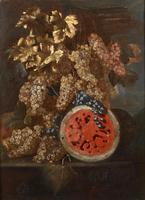
Composition aux grappes de raisins et à la pastèque
Giovanni Battista Ruoppolo
Fruit, a Nest and Insects in a Wood
Rachel Ruysch
Still life with grapes and other fruit on a platter, a glass vase with tulips, a melon, apricots, cherries and other fruit, all on a ledge
Jan van Kessel the Elder
Still Life of fruit in a Wan-li Bowl
Osias Beert
A Chinese bowl with apples, plums, grapes and nuts
Osias Beert
Fruit still life with flower tazza, squirrel, and jar
Jan van Kessel the Elder
Garden Orchard and Vine
Currier and Ives
A STILL LIFE
Abraham Mignon
Großes Früchtestillleben mit Pilzen
Giovanni Battista Ruoppolo
Still Life with Fruit a Nest and a Lizard
Rachel Ruysch
Nature morte au melon
Jan van Os
Rich Still Life with Flowers and Fruit
Adalbert Schaffer
Still Life
Ilya Mashkov
Flowers, Fruit, Reptiles, and Insects on the Edge of a Wood
Rachel Ruysch