Analisi esperta di A 12 di Tadasky
Stile: Op Art · Genere: abstract
Expert Art Historical Analysis: "A 12" by Tadasky
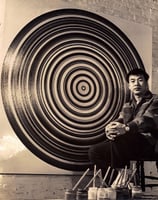
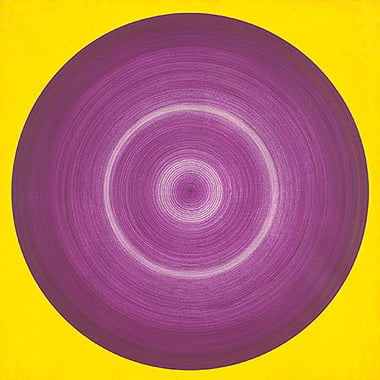
Tadasky (born Tadasuke Kuwayama, 1935) is a key figure in the Op Art movement, and A 12 stands as a quintessential example of his meticulous, perceptual investigations. Created in the mid-1960s during Op Art’s peak, the work is a pure, abstract composition that relies on carefully calibrated optical effects rather than representational content.
Formal and Perceptual Significance
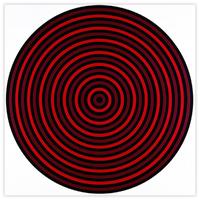
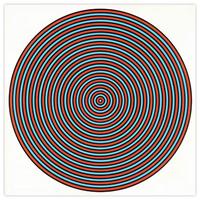
At its core, A 12 consists of a series of perfectly concentric circles—a hallmark of Tadasky’s practice—rendered in alternating, high-contrast hues (often black and white, or vivid primary colors). The precise, machine-like execution of the circles creates a powerful visual vibration: the viewer’s eye cannot rest, instead experiencing a sensation of rotation, expansion, or afterimage flicker. This phenomenon, known as the “moiré effect,” is produced by the subtle interplay of spatial frequency and color contrast. Tadasky exploited this to challenge the stability of perception, forcing the viewer to confront the physiological limits of sight.
Context within Op Art
Op Art (Optical Art) emerged in the 1960s as a movement that rejected emotional expression in favor of systematic, scientific investigations of visual perception. Tadasky’s A 12 is significant because it exemplifies the movement’s core ambition: to create art that exists less as a static object and more as a dynamic, living experience within the viewer’s eye. Unlike contemporaries such as Victor Vasarely or Bridget Riley, who often used complex geometric grids or wavy patterns, Tadasky’s radical simplification—the single motif of concentric circles—isolates the optical effect to its purest form. This reductionist approach aligns him with Minimalist sensibilities, yet his work remains firmly rooted in Op Art’s perceptual aims.
Significance and Legacy
*Tadasky’s A 12 is significant for its demonstration that the simplest geometric form can generate the most complex sensory illusions. The piece functions as a kind of “perceptual machine,” revealing how the brain constructs (and often misconstructs) spatial and chromatic reality. It also exemplifies the era’s fascination with science, psychology, and the mechanics of vision—themes that connected contemporary art to emerging fields like Gestalt psychology and computational optics. Today, A 12 is celebrated as a masterwork of rigorous abstract optical art, a reminder that profound aesthetic experience can arise from the most disciplined formal constraints.
Visivamente simili
20 opere con composizione e palette affini
F 112
Tadasky
Los Angeles (Wilma)
Jill Baroff
Ma 102
Tadasky
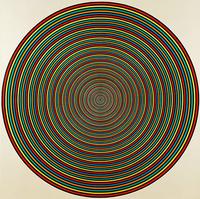
A 100
Tadasky
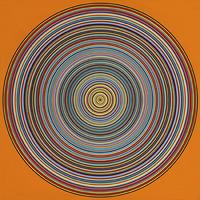
D 105a
Tadasky
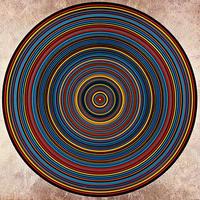
D 112
Tadasky
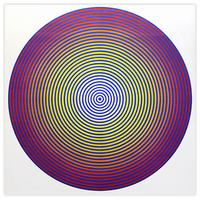
C 136
Tadasky
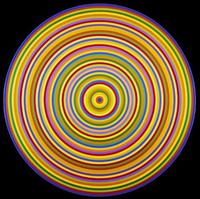
Chromatic Accelerator
Claude Tousignant
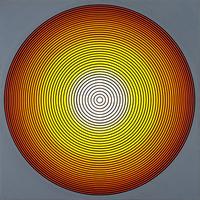
D 124
Tadasky
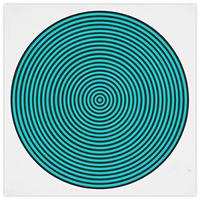
B 160
Tadasky
C 133a
Tadasky
Cosmochromatique
Martha Boto
A 2
Tadasky
B 108
Tadasky
Composition 523 n°10-8
Julio Le Parc
Composition 523 n°12-7
Julio Le Parc
Red Mandala
Clarence Holbrook Carter
Icon Pyrophorous
Clarence Holbrook Carter
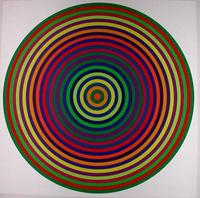
Composition 523 n°13-5
Julio Le Parc
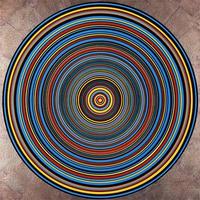
D 114
Tadasky