Expertenanalyse zu Tadaskys C 200
Stil: Op Art · Genre: abstract
Expert Analysis of C 200 by Tadasky
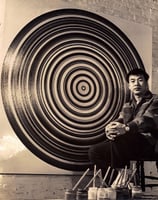
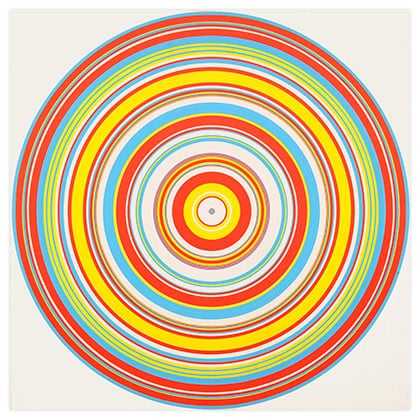
Tadasky (born Tadasuke Kuwayama) stands as a pivotal figure in the Op Art movement of the 1960s, and C 200 epitomizes the movement’s core ambition: to create purely abstract compositions that actively deceive and challenge the viewer’s visual system. As an Op Art abstract piece, C 200 is not merely a picture to be looked at, but a perceptual event to be experienced.
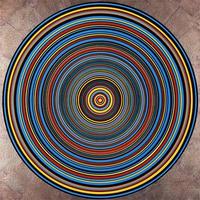
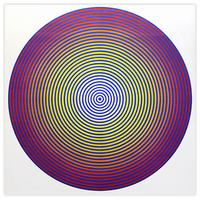
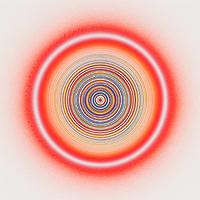
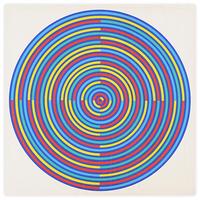
The work’s significance lies in its masterful exploitation of optical color interaction and moiré patterns. Tadasky typically employed a tightly ruled series of concentric circles (a motif he explored in his “C” series). In C 200, the precise, hand-painted concentric bands of saturated color (likely intense primaries or complementary pairs) are spaced so evenly that the eye cannot fixate on any single point. This creates two powerful effects: first, a kinetic vibration – the circles appear to pulse, rotate, or ripple outward from the center, despite being perfectly static; second, persistent afterimages – staring at the center and then looking away leaves a ghostly negative-image ring in the viewer’s vision. This is a hallmark of Op Art’s use of physiological illusions.
Within the Op Art genre, Tadasky’s contribution is unique for its combination of systematic precision with intuitive color harmony. Unlike some contemporaries who relied on harsh black-and-white contrasts, Tadasky used chromatic interaction to generate movement. C 200 likely demonstrates this through the phenomenon of “color spreading” (the Bezold effect) or through simultaneous contrast along edges, where the boundaries between hues appear to blur and shimmer. The “200” in the title likely refers to a specific configuration of color relationships or ring count, emphasizing the serial, systematic approach that characterizes Tadasky’s practice.
Ultimately, C 200 is significant because it pushes abstract art beyond representation or expression into the realm of pure sensory psychology. It is a controlled laboratory for visual perception, where the viewer’s own eye becomes the subject of the artwork. Tadasky’s work was famously exhibited in MoMA’s seminal 1965 “The Responsive Eye” exhibition, and C 200 encapsulates why: it demonstrates that abstraction can be rigorously formal yet deeply disorienting, forcing a new awareness of how seeing itself functions.
Visuell ähnlich
20 Werke mit ähnlicher Komposition und Farbpalette
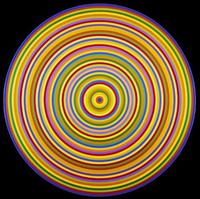
Chromatic Accelerator
Claude Tousignant
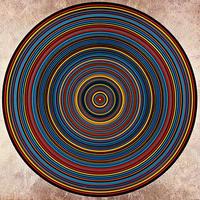
D 112
Tadasky
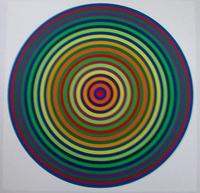
Composition 523 n°12-7
Julio Le Parc
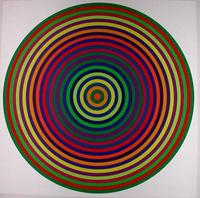
Composition 523 n°13-5
Julio Le Parc
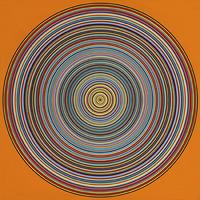
D 105a
Tadasky
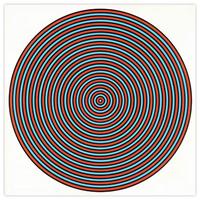
B 108
Tadasky
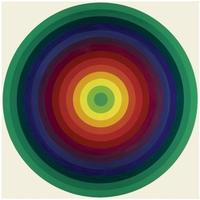
Serie 14 N - 4E
Julio Le Parc
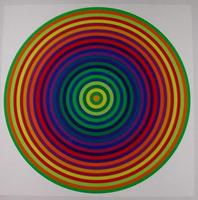
Composition S -14 - 4
Julio Le Parc
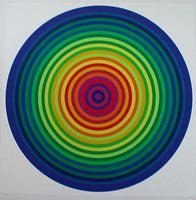
Composition 523 n°10-8
Julio Le Parc
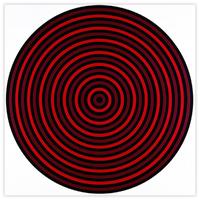
C 133a
Tadasky
D 114
Tadasky
C 136
Tadasky
F 112
Tadasky
C 159
Tadasky
Beginning
Kenneth Noland
B 160
Tadasky
Oeil de boeuf
Claude Tousignant
Mandala I
John McCracken
Spring Cool
Kenneth Noland
D 124
Tadasky