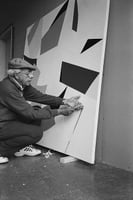
Экспертный разбор работы «Mousse d'Étoiles» художника Marcel Barbeau
Стиль: Abstract Expressionism · Жанр: abstract
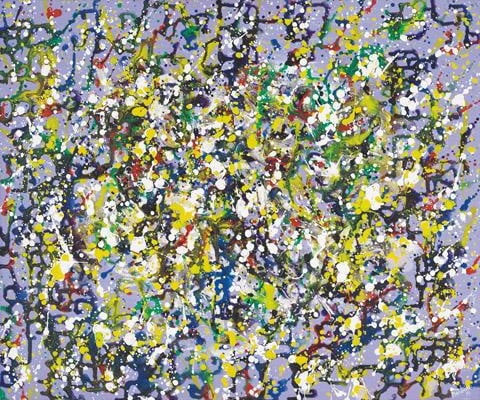
Analysis of "Mousse d'Étoiles" by Marcel Barbeau
Marcel Barbeau’s "Mousse d’Étoiles" (Foam of Stars) stands as a compelling example of mid-20th‑century Abstract Expressionism, specifically channeling the movement’s emphasis on spontaneous gesture, materiality, and emotional resonance. While the work is purely abstract — devoid of recognizable subject matter — its significance lies in how Barbeau adapts the core tenets of Abstract Expressionism to a distinctly Canadian context, bridging the energetic gesturalism of the New York School with the lyrical, organic impulses of the Automatiste movement he helped found.
The title itself — evoking celestial foam — suggests a cosmic, almost fluid origin for the composition. Barbeau likely employs broad, sweeping strokes and layered impasto, a hallmark of Abstract Expressionist painting, to create a sense of weightless expansion and turbulent energy. The “stars” may manifest as bursts of lighter pigment or as negative spaces that push and pull across the canvas, while the “foam” implies a delicate, ephemeral texture achieved through thinned paint or tool marks. This dual quality — between the explosive and the airy — is key to the work’s significance: it captures the tension between control and accident that defines the best Abstract Expressionist canvases.
Art historically, "Mousse d’Étoiles" is important because it situates Barbeau within the global dialogue of abstract art in the 1950s–60s, but with a local inflection. As a signatory of the 1948 Refus Global manifesto, Barbeau rejected academic naturalism in favor of automatism and psychic improvisation. Yet his later works, including this one, also absorb the scale and bravura of American Abstract Expressionism, while maintaining a lighter, more atmospheric touch — a “northern” sensibility often noted in his oeuvre. The painting therefore exemplifies the cross‑pollination between Parisian tachisme, New York action painting, and Quebec’s own avant‑garde, making it a pivotal contribution to the history of Canadian modernism and a testament to abstract expressionism’s capacity for personal, poetic expression.
Жанр
Визуально похожие
20 работ с близкой композицией и палитрой
Number 6
Jackson Pollock
Lucifer
Jackson Pollock
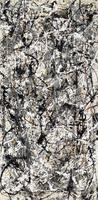
Cathedral
Jackson Pollock
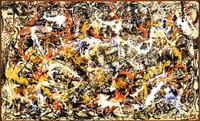
Convergence (Number 10)
Jackson Pollock
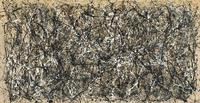
One: Number 31
Jackson Pollock
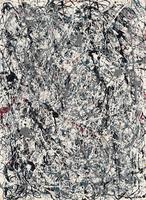
Number 19
Jackson Pollock
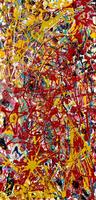
Primal Star Twin #2
Jack Armstrong
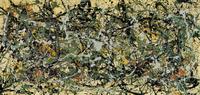
Number 8
Jackson Pollock
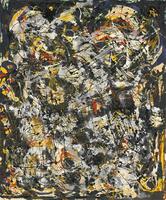
Number 4
Jackson Pollock
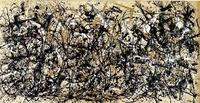
Autumn Rhythm (Number 30)
Jackson Pollock
Untitled
Antonio Sanfilippo
Travel Tobey
Mark Tobey
Advance of History
Mark Tobey
Reflection of the Big Dipper
Jackson Pollock
No. 1
Jackson Pollock
Mural on Indian red ground
Jackson Pollock
Cosmic X Humanity
Jack Armstrong
Homenaje a Gora
Requena Nozal
Number 3
Jackson Pollock
Untitled
Henri Michaux