Analisi esperta di Rosier-feuilles di Marcel Barbeau
Stile: Abstract Expressionism · Genere: abstract
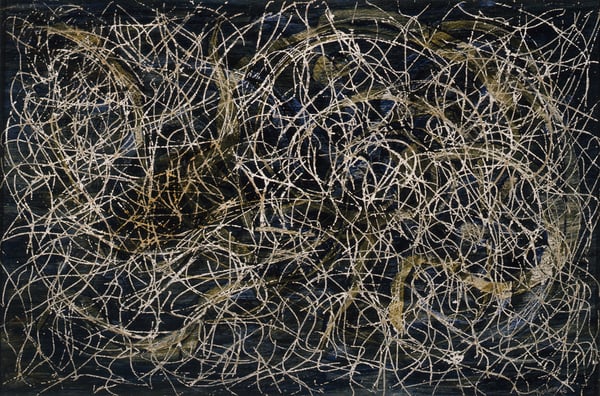
Expert Analysis of Marcel Barbeau’s Rosier-feuilles (c. 1950s–60s)
As an abstract expressionist work by the Canadian painter Marcel Barbeau, Rosier-feuilles exemplifies the tension between gestural spontaneity and organic form that defines his most significant contributions to mid‑20th‑century abstraction. Barbeau was a key figure in the Montréal-based Automatiste movement—a radical offshoot of Surrealism that privileged automatic writing and painting as a means of accessing the subconscious. His practice aligns with the broader American Abstract Expressionist ethos, yet retains a distinctly lyrical, nature‑derived vocabulary.
What the Title Reveals
The title Rosier-feuilles (French for “rosebush-leaves”) immediately signals a botanical, almost microscopic inspiration. Unlike many Abstract Expressionists who sought pure, non‑referential gesture, Barbeau often anchored his compositions in natural motifs—leaves, stems, blossoms—transformed through rapid, intuitive mark‑making. Here, the “rosebush” is not depicted but felt: swirling arcs, dappled color patches, and spiky linear accents evoke the delicate yet thorny structure of a living plant.
Stylistic and Technical Significance
- Gesture and Automatism: Barbeau’s brushwork is impulsive and fluid. In Rosier-feuilles, broad, sweeping strokes of greens, ochres, and pinks intersect with sharp, calligraphic marks, suggesting the push‑and‑pull of organic growth. This technique owes much to the Automatistes’ belief that the hand should move freely, guided by internal rhythm rather than conscious planning. The painting thus becomes a record of the artist’s physical and psychic energy in real time.
- Color as Atmosphere: Instead of bold, high‑key hues typical of New York School painting, Barbeau employs a soft, earthy palette—muted greens, dusty roses, pale yellows—that carries a muted, northern light. This chromatic restraint gives Rosier-feuilles a meditative, almost melancholic quality, distinct from the aggressive brushiness of a Pollock or de Kooning.
- Compositional Structure: The painting’s surface is dense but not chaotic. Barbeau organizes his marks around an implied central axis—like a stem—from which lateral “leaves” radiate. This latent structure prevents complete dissolution into pure gesture, grounding the work in the natural world even as abstraction prevails.
Place within Abstract Expressionism and the Automatiste Movement
Rosier-feuilles is significant because it bridges two crucial currents: American Abstract Expressionism and Canadian Automatism. Where Abstract Expressionists often sought mythic or existential content, Barbeau and his peers (including Paul‑Émile Borduas and Jean‑Paul Riopelle) retained a concrete connection to the landscape and the body. The painting’s organicism prefigures later developments in Lyrical Abstraction and Tachisme by a few years, demonstrating that the global language of gestural abstraction was being inflected with local sensibilities. Barbeau’s refusal to abandon the title’s natural reference—and the delicate, leafy forms that realize it—makes Rosier-feuilles a compelling example of how Abstract Expressionism could be intimate rather than monumental, poetic rather than heroic.
In sum, Rosier-feuilles stands as a testament to Marcel Barbeau’s mastery of automatic techniques and his ability to channel the rhythms of the natural world into a purely abstract visual language. It is a quietly radical work that enriches our understanding of mid‑century abstraction beyond the New York paradigm.
Visivamente simili
20 opere con composizione e palette affini
Cathedral
Jackson Pollock
Autumn Rhythm (Number 30)
Jackson Pollock
Untitled
Emily Kame Kngwarreye
Number 3
Jackson Pollock
Convergence (Number 10)
Jackson Pollock
Number 5
Jackson Pollock
Number 19
Jackson Pollock
Number 6
Jackson Pollock
Mural on Indian red ground
Jackson Pollock
No. 1
Jackson Pollock
Autumn Rhythm (Number 30)
Jackson Pollock
Number 17
Jackson Pollock
One: Number 31
Jackson Pollock
Work
Akira Kanayama
Composition
Behjat Sadr
Phornix Park
Asger Jorn
Kame Awelye
Emily Kame Kngwarreye
Number 48
Jackson Pollock
Number 13A (Arabesque)
Jackson Pollock
Untitled (Green Silver)
Jackson Pollock