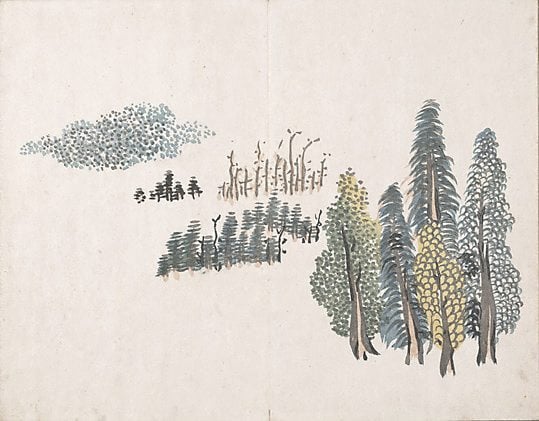
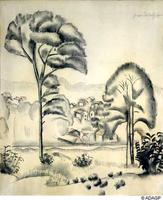
Untitled (a tree)
Analisi esperta di Untitled (a tree) di Ike no Taiga
Stile: Nanga (Bunjinga) · Genere: landscape
Expert Analysis: “Untitled (a tree)” by Ike no Taiga
Ike no Taiga (1723–1776) stands as one of the most innovative and influential masters of the Nanga (Bunjinga) school—Japanese literati painting that drew deeply from Chinese scholar-artist traditions. In this work, “Untitled (a tree)”, Taiga distills the essence of the landscape genre into a single, concentrated motif, demonstrating the core Nanga principle that a humble subject, rendered with expressive spontaneity, can evoke the vastness of nature itself.
The significance of this painting lies in its embodiment of Nanga’s philosophical core: the artist’s personal cultivation and emotional resonance matter more than mimetic accuracy. Taiga, known for his bold, idiosyncratic brushwork and his fusion of Chinese ink-painting techniques with a distinctly Japanese sensibility, here reduces a landscape to a singular tree—likely a pine or a willow—executed with rapid, calligraphic strokes. The “untitled” nature of the work further underscores the literati ideal of leaving room for the viewer’s imagination; the tree is not a specific specimen but a universal symbol of endurance, transformation, and the artist’s inner state.
Within the Nanga (Bunjinga) style, Taiga’s approach was revolutionary. While earlier Japanese literati painters closely followed Chinese models, Taiga injected a fresh, almost playful vigor into his compositions. In Untitled (a tree), the twisting trunk and sparse foliage are rendered with a dynamic economy of line—each mark is both structural and expressive. This aligns with the Nanga emphasis on yojō (overtones) and shasei (sketching from life), but Taiga goes further by integrating rustic Japanese ink textures with the lyrical abstraction of Chinese masters like Mi Fu.
The work is significant as a microcosm of Taiga’s mature style: seemingly simple yet deeply sophisticated. It reflects the Nanga rejection of the decorative formalism of the Kano and Tosa schools, favoring instead the raw, cultivated simplicity of the literati amateur. A single tree becomes a landscape: the branches suggest mountain paths, the roots hint at rocky terrain, and the blank space around it breathes as mist or sky. Taiga’s genius lies in making the invisible—wind, time, solitude—visible through the barest of means. This painting stands as a quiet manifesto of Bunjinga ideals, proving that in the hands of a master, one tree can hold the universe.
Visivamente simili
20 opere con composizione e palette affini
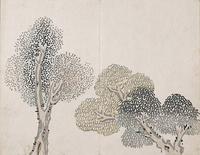
Untitled (a tree with small leaves)
Ike no Taiga
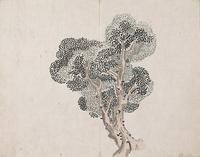
Untitled (a tree without leaves)
Ike no Taiga
Paysage au croissant de lune
Zao Wou-Ki
Vaszary János, Park 1911
Vaszary János
Vaszary János, Park 1911
Vaszary János
Evening Snow on Mount Hira
Hiroshige
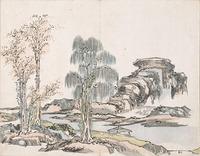
Untitled (Mountains and three trees)
Ike no Taiga
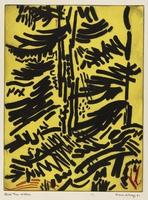
Dark Trees at Noon
Karl Schrag
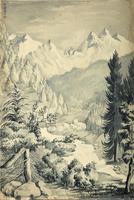
Shikaargah ka saundarya
Sukhvir Sanghal
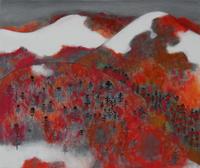
Untitled
Viorel Marginean
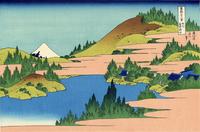
The lake of Hakone in the Segami province
Katsushika Hokusai
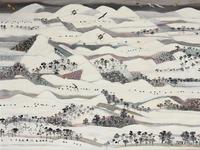
Winter at Cenade
Viorel Marginean
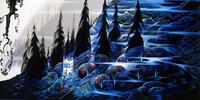
Black Spruce
Eyvind Earle
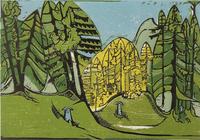
Forest Cemetery
Ernst Ludwig Kirchner
Monhegan (study)
Nicholas Roerich
Fugue
Mikalojus Konstantinas Ciurlionis
Mist in the Valley of the Arc
Andre Masson
23. Chiyogaike Pond in Meguro
Hiroshige
Landscape of Algeria
Jean Dubuffet
Schwarzheide
Luc Tuymans