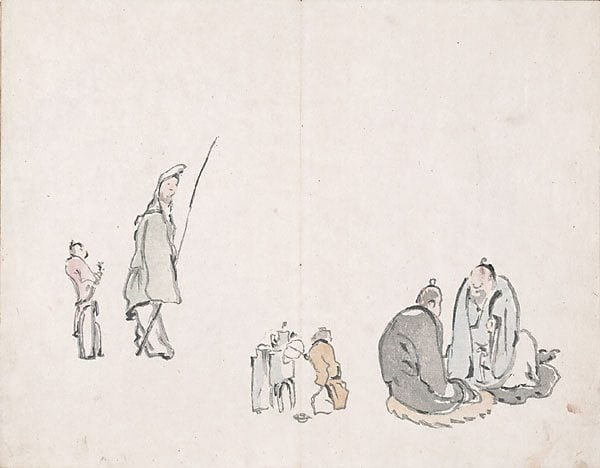
Untitled (Figures)
Expertenanalyse zu Ike no Taigas Untitled (Figures)
Stil: Nanga (Bunjinga) · Genre: sketch and study
Expert Analysis: "Untitled (Figures)" by Ike no Taiga
Ike no Taiga (1723–1776) is a central figure in the Nanga (Bunjinga) school, the Japanese adaptation of Chinese literati painting. This work, a sketch and study, is significant precisely because it exemplifies the core ideals of the Nanga tradition: spontaneity, personal expression, and the cultivation of the artist’s inner spirit over polished, academic finish.
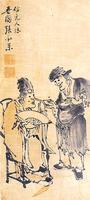
As a sketch, "Untitled (Figures)" offers a rare window into Taiga’s creative process. Unlike finished works meant to impress patrons, this study captures the artist’s immediate, unguarded hand. The loose, expressive brushwork—characteristic of Taiga’s mature style—reveals the influence of Chinese masters such as Dong Qichang and the eccentric Eight Eccentrics of Yangzhou. Yet Taiga transforms these influences into a distinctly Japanese idiom, using swift, calligraphic strokes to evoke movement, emotion, and the fleeting essence of his figures rather than anatomical precision.
The significance of this piece lies in its embodiment of the literati ideal: art as a reflection of the artist’s character and cultivation. In Nanga, a sketch carries as much weight as a finished painting, if not more, because it reveals the artist’s unmediated sensibility. Taiga was renowned for his bold, unconventional style, and this study demonstrates his ability to distill complex human forms into minimal, evocative marks. The figures, though not fully rendered, possess a lively, gestural quality—suggesting conversation, movement, or quiet introspection—that invites the viewer to complete the narrative.
Furthermore, this work situates Taiga within the broader cultural project of bunjin (literati) art in Edo-period Japan, where amateur painters sought to emulate the free-spirited, anti-academic ethos of Chinese scholar-painters. As a sketch, it challenges the formal hierarchies of painting at the time, elevating spontaneous expression over commissioned commercial work. In doing so, "Untitled (Figures)" not only demonstrates Taiga’s mastery but also embodies the very soul of Nanga: art as a living, breathing extension of the self.
Visuell ähnlich
20 Werke mit ähnlicher Komposition und Farbpalette
Untitled (Figures)
Ike no Taiga
Untitled (Figures)
Ike no Taiga
Drawing of Seated Nobleman in Full Costume
Katsushika Hokusai
Painting of Cuju
Huang Shen
Man alone
Shitao
Opera Figures
Ding Yanyong
Immortals Celebrating a Birthday
Chen Hongshou
Opera Figures
Ding Yanyong
A Night Banquet at Peach and Plum Garden in Spring
Huang Shen
The Nineteen Taoist Immortals
Kim Hong-do
Manga
Katsushika Hokusai
Drinking Tea
Huang Yongyu
A monkey trainer performing at a noblemans house,
Kitagawa Utamaro
Blacksmith Munechika, helped by a fox spirit, forging the blade Little Fox
Ogata Gekko
Li Bai's Drunken Calligraphy
Ding Yanyong
Portrait of Rikyû
Shibata Zeshin
Fisherman and Fisherwoman
Huang Shen
Seven Gods of Good Fortune
Hakuin Ekaku
Storytelling
Owon
Gaoshi
Fu Baoshi