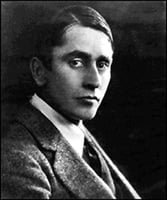
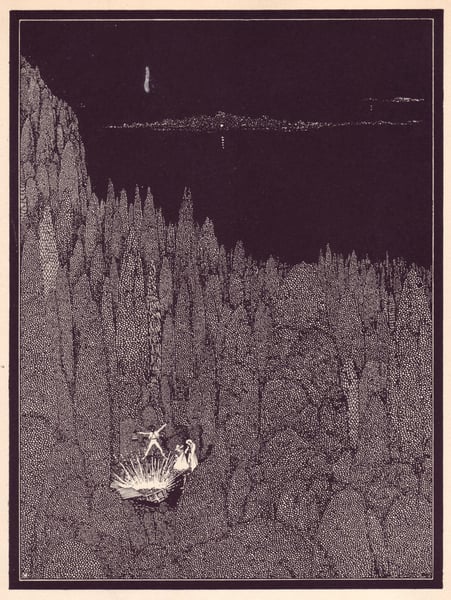
Harry Clarke sanatçısının Tales of Mystery and Imagination by Edgar Allan Poe eseri hakkında uzman analizi
Tarz: Art Nouveau (Modern) · Tür: illustration
Expert Analysis: "Tales of Mystery and Imagination by Edgar Allan Poe" by Harry Clarke
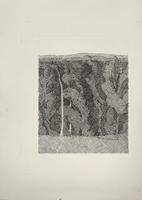
Harry Clarke’s illustrations for Tales of Mystery and Imagination represent a landmark fusion of Art Nouveau’s sinuous elegance with the gothic, psychological terror of Edgar Allan Poe’s prose. Within the Art Nouveau movement (often defined by organic, flowing lines, decorative richness, and a harmony between form and function), Clarke’s work stands apart for its dark, highly detailed, and macabre sensibility—a departure from the more pastoral or ethereal works of contemporaries like Alphonse Mucha or Aubrey Beardsley.
Significance within Art Nouveau and the Illustration Genre:
-
Mastery of the “Dark Nouveau” Aesthetic: While Art Nouveau typically celebrated natural beauty and feminine grace, Clarke injected a sublime horror into the style. His use of intricate, lace-like linework, deep blacks, and eerie, elongated figures directly channels Poe’s atmosphere of dread. This makes the illustrations not mere accompaniments but visual equivalents of Poe’s psychological intensity.
-
Innovative Stained-Glass Technique in Print: Trained as a stained-glass artist, Clarke brought that medium’s luminous, compartmentalized quality to his ink drawings. His illustrations for Tales of Mystery and Imagination often feature densely packed, ornamental borders and panels that echo stained-glass windows. This technique gives the horror a liturgical, almost sacred weight—transforming Poe’s stories into modern Gothic cathedrals of print.
-
Narrative and Symbolic Density: Every element in Clarke’s compositions—from the swirling vines to the skeletal faces hidden in architectural details—serves the story. Unlike many pure Art Nouveau decorative works, Clarke’s illustrations are deeply symbolic and narratively driven. For example, his rendering of “The Pit and the Pendulum” uses the curved blade, the pit’s abyss, and the trapped figure to create a single, breathless visual moment that mirrors Poe’s mounting panic.
-
Influence on Book Illustration and Gothic Art: This collection (first published in 1919) cemented Clarke’s reputation as the preeminent illustrator of Poe’s works. His style influenced later horror and fantasy illustrators (e.g., Edward Gorey, Berni Wrightson) who blend decorative intricacy with macabre themes. It also demonstrates how Art Nouveau could transcend mere decoration and become a vehicle for intense emotional and psychological expression.
Conclusion: Harry Clarke’s Tales of Mystery and Imagination is significant because it pushed Art Nouveau into darker, more literary territory, proving the style’s versatility. By marrying the movement’s ornamental grace with Poe’s gothic dread, Clarke created a visual language that remains the definitive interpretation of Poe’s mysteries—a haunting, beautiful synthesis of sinuous line and shadow.
Görsel olarak benzer
İlişkili kompozisyon ve renk paletine sahip 20 eser
Tales of Mystery and Imagination by Edgar Allan Poe
Harry Clarke
Black Spruce
Eyvind Earle
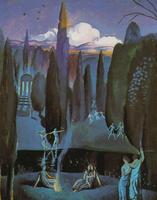
Nymphs in a Romantic, Garden
Salvador Dali
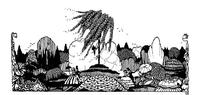
The Year's at the Spring
Harry Clarke
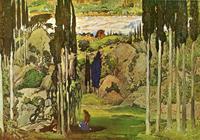
"Daphnis and Chloe" set design
Leon Bakst

Spirit Grove
Eyvind Earle
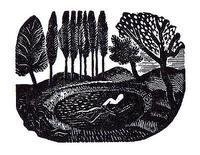
SWIMMER
Eric Ravilious
Elisium
Leon Bakst
A Landscape Study
Harry Phelan Gibb
Funeral Symphony (IV)
Mikalojus Konstantinas Ciurlionis
Tanglewood
Ivan Eyre
Autumn Eucalyptus
Eyvind Earle
Landscape with overhanging fir
Hercules Seghers
Armenia
Martiros Sarian
Study of scene design for "Snow Maiden"
Nicholas Roerich
Lava Flow from Etna
M.C. Escher
Suprunivka
Pavlo Makov
Fiesole, Italy
Anna Ostroumova-Lebedeva
Black Spruce
Eyvind Earle
Landscape
Hryhorii Havrylenko